

The online world today is highly connected, with all the information we need available to us at our fingertips at all times. But how do these online systems work seamlessly to give us a good experience in real time? Achieving any task involves the participation of more than one single entity; nothing can function in isolation by itself. Independent online systems come together and communicate to share data, making all online services valuable.
What are WebHooks?
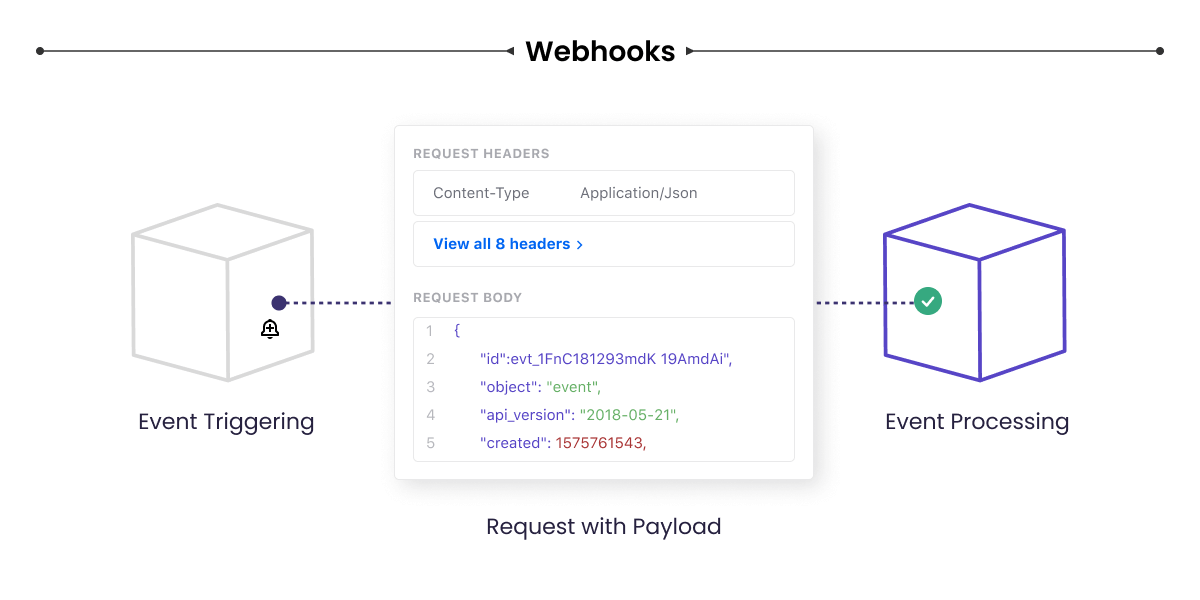
Webhooks are a way in which applications can send automated messages or information to other applications. It is a Hypertext Transfer Protocol (HTTP) request triggered by an event in a source system and sent to another system (destination), often with a payload of data. Webhooks are automatically sent out to the destination systems when their event is fired in the source system.
Webhooks have a message, also known as a payload, sent to a unique Uniform Resource Locator (URL), essentially the app’s address or phone number. Let’s understand this better by comparing webhooks to SMSs. Whenever you make a purchase, your bank notifies you about the transaction. For example, “You just spent ₹500 at Starbucks.” You already shared your phone number with the bank, so you received the message. The process is similar to webhooks.
You might get webhook requests in these forms – GET or POST requests, depending on which webhooks provider you use. GET webhook requests are simple and have their payload (message) appended to the webhook URL as a query string (a part of the URL that assigns values to the specified parameter). POST webhook requests have their payload or message in the request body and might contain properties like authentication tokens.
Why are WebHooks important?
Webhooks are known to be called ‘user-defined callbacks made with HTTP.’ They are data, and executable commands are sent from one application (source) to another (destination) over HTTP instead of through the command line on a computer, formatted in XML, JSON, or form-encoded serialization. Webhooks are software hooks, or functions that run when something happens or an event gets triggered, that work over the web. And they are typically secured through obscurity – each user of an application gets a unique, random URL to send webhook data to – though they can also be optionally secured with a key or signature.
Webhooks are crucial because they provide users with efficiency an ETA (Estimated Time of Arrival) management. Here are some reasons why using webhooks is essential:
-
- Update membership lists seamlessly.
Webhooks help you update the membership records of customers to the membership management software you use whenever your customers make subscription payments. Webhooks automate the membership management process, which frees you from the labor of manually monitoring and updating your subscriptions periodically. The payment platform sends the customer details to the membership management app.
-
- Save your work and time.
Webhooks help you save time by communicating with other apps to alternate processes. They notify your Customer Relationship Management (CRM) software whenever a customer subscribes. Moreover, they also help you to sync changes, such as when a customer alters their email address.
-
- Connect payment getaways to your email address
There are numerous online payment gateways available, and most use webhooks rather than APIs Webhooks will send information from the payment gateway to your email address to notify you of the payment information. An Application Programming Interface (API) is a software interface that acts as a link between computers and applications, while a webhook is a way for one app to deliver data to another app in real-time.
Conclusion
In today’s world, information rules the internet. Getting data in real-time makes online services more efficient and appealing to customers’ needs. Webhooks, in this case, offer an automated, non-complex way to make sharing information in real-time possible amongst online platforms. Learn more about webhooks today, get in touch with us.