

Average Open Rate
Email marketing stands as a powerful tool to establish connections with both existing customers and potential prospects. However, the ever-increasing influx of emails in today’s digital landscape poses a significant challenge in capturing the attention of recipients and making your messages stand out. Amidst this scenario, measuring the open rate emerges as a crucial metric to assess the effectiveness of your email campaigns. The open rate signifies the percentage of recipients who actively engage with your email by opening it.
This article aims to delve into the concept of average open rate, decode its significance, and explore strategies to leverage this metric to enhance the outcomes of your email marketing efforts.
What is average open rate?
The average open rate is the average percentage of recipients who opened an email in a particular campaign or over a specified period. It is a critical email marketing metric as it evaluates the success of your email marketing efforts by providing insights into the effectiveness of your email campaigns. A higher open rate implies that your subject lines, preheaders, and sender name resonated well with your subscribers, resulting in a higher likelihood of engagement.
Calculating Average Open Rate
The formula for calculating the average open rate is simple:
Average Open Rate = (Total opens / Total emails sent) x 100
For instance, if you sent 100 emails and 20 recipients opened them, your average open rate would be 20%.
What is a good open rate?
The average open rate can differ based on factors such as industry, target audience, and the type of email being sent. According to recent research, the average open rate across industries is 18%. However, this can be misleading, as some industries have much higher open rates.
For instance, nonprofits have an average open rate of 25.18%, while media and publishing have an average of 22.86%. Therefore, it is essential to benchmark your email campaigns against your industry’s average open rate and strive to improve it.
Factors that Affect Open Rates
Several factors can affect your email open rates, including:
- Subject Line
Subject Line The subject line serves as the initial impression for your subscribers when they receive your email. It is vital to create a subject line that is enticing, concise, and directly relevant to the content within your email. - Preheader
The preheader, which appears below or alongside the subject line, offers a preview of the email’s content. It provides subscribers with a glimpse into what they can expect from the email and can serve as reinforcement for the subject line. - Sender Name
Your sender name should be recognizable and trustworthy to your subscribers. Replacing a generic email address with a personalized name can also contribute to higher open rates. - Email Content
It is important to create email content that is engaging, relevant, and tailored to audience interests and needs. Personalization can be achieved by segmenting your email list and sending targeted messages to each segment. - Email Timing
The timing of your email can also affect your open rates. For instance, sending your email during the weekends or holidays may result in lower open rates as most people are away from work and are not checking their emails.
How to Improve Your Open Rates
Now that we understand what open rates are and what affects them, let’s look at some ways to improve them:
- Personalization
By tailoring your emails to include your subscribers’ names, interests, and preferences, you can enhance personalization and ultimately improve your open rates. Additionally, segmenting your email list and sending targeted messages to specific segments can further optimize engagement. - Optimize Subject Lines
You can boost your open rates by creating captivating and relevant subject lines that resonate with your subscribers. Implementing A/B testing techniques can help identify the most effective subject lines for your specific audience - Improve Email Content
Your email content should be engaging, relevant, and personalized. Using images, videos, and interactive elements can also make your email more appealing to your subscribers. - Test and Experiment
Conducting tests and experiments with various elements in your emails allows you to discover the most effective strategies for engaging your audience. By testing subject lines, preheaders, sender names, email content, and timing, you can gather valuable insights and optimize your email campaigns to resonate with your subscribers. - Keep Your List Clean
Maintaining a clean email list by regularly removing inactive or bounced email addresses can improve your open. This practice enhances your open rates by targeting engaged subscribers who are more inclined to open and interact with your emails. - Use Engaging Preheaders
Your preheader can be a valuable asset in enticing subscribers to open your emails. Use it to provide additional context, highlight a key benefit, or create a sense of urgency.
Conclusion
In conclusion, the average open rate is a powerful indicator of your email marketing success, reflecting the level of engagement and interest among your subscribers. By consistently analyzing and improving your open rates through effective strategies like personalization, compelling subject lines, testing, and maintaining a clean email list, you can unlock higher levels of engagement and drive meaningful interactions with your audience. Embracing these practices empowers you to build stronger connections, deliver relevant content, and ultimately achieve greater success in your email marketing campaigns.
FAQs
- What is a bounce rate in email marketing?
The bounce rate in email marketing is the percentage of email addresses in your list that did not receive your email due to factors such as invalid email addresses or technical issues. - What is a click-through rate in email marketing?
The click-through rate in email marketing is the percentage of recipients who clicked on a link in your email. - Can I improve my open rates without personalizing my emails?
Yes, you can improve your open rates by optimizing your subject lines, preheaders, sender names, and email content - How often should I clean my email list?
A/B testing involves comparing two distinct versions of an email to evaluate and identify the version that delivers better performance and results. - What is A/B testing?
A/B testing is a method of comparing two different versions of an email to determine which one performs better. It involves sending both versions to a small portion of your email list and measuring their performance before sending the winning version to the rest of your list.
Android Push Notifications
Mobile applications have become an essential part of our daily lives, and push notifications are an integral part of mobile app development. Android push notifications, in particular, are a powerful tool that can help businesses stay connected with their users and improve user engagement.
Definition of Android Push Notifications
Android push notifications are alerts that are displayed on a user’s mobile device, even when the app is not actively running. They are messages that are sent by a mobile app developer to their users through the Google Firebase Cloud Messaging (FCM) service.
Importance of Push Notifications
Push notifications can help businesses to keep their users engaged and informed. They can also help to improve user retention and app usage. Push notifications serve multiple purposes, such as notifying users about fresh content, reminding them of upcoming events or deadlines, or delivering valuable information to enhance their user experience.
How Android Push Notifications Work
The Push Notification Process
When a push notification is dispatched to a user’s device, it is directed through the Firebase Cloud Messaging (FCM) service. The FCM service then delivers the notification to the user’s mobile device, where it is displayed to the user.
The Role of Firebase Cloud Messaging (FCM)
Firebase Cloud Messaging (FCM) provides developers with a platform to send notifications to users specifically on Android devices. FCM provides a reliable and scalable way to deliver messages to users, and it is integrated with other Firebase services like Firebase Analytics.
Different Types of Notifications
Android push notifications can be of various types, including:
- Normal Notifications: These are the standard notifications that appear in the user’s notification tray.
- Heads-Up Notifications: These notifications appear at the top of the screen and require the user’s immediate attention.
- In-App Notifications: These notifications appear within the app itself and can be used to provide context-specific information.
Creating Android Push Notifications
- Registering with Firebase Console
In order to deliver push notifications to your users, you need to register your app with the Firebase Console. Following the registration, you can proceed to configure FCM and start sending notifications. - Configuring Firebase Cloud Messaging
After registering your app, you need to configure Firebase Cloud Messaging. This involves generating a unique key that identifies your app to the FCM service. - Creating Notifications using Firebase Cloud Messaging
To create notifications using Firebase Cloud Messaging, you can use the Firebase Console or the Firebase API. You can customize the notification’s title, body, and icon to provide relevant information to your users. - Customizing Notifications
Customizing notifications can help to improve user engagement. You can customize notifications based on user preferences, behavior, and demographics to provide personalized content to them. You can also add CTA buttons to your notifications, which can nudge users to take an action directly from the notification itself.
Best Practices for Android Push Notifications
- Choosing the Right Time to Send Notifications
Sending notifications at the right time can help to improve user engagement. You should send notifications when users are most likely to be active on their devices, such as during the daytime or on weekends. - Providing Clear and Concise Information
Notifications should be concise and clear, delivering relevant information to users in a manner that is easy to understand. Avoid using technical jargon or overly complicated language. - Personalizing Notifications
Personalizing notifications can help to improve user engagement. You can optimize user data to tailor notifications as per their interests, preferences, and behavior. - Avoiding Notification Overload
Sending too many notifications can be overwhelming for users and can lead to notification fatigue. Refrain from sending excessive notification frequency within a short timeframe, and provide users with the choice to opt-out of notifications if desired.
Measuring the Success of Android Push Notifications
- Understanding the Analytics
Analyzing push notification analytics can help you to measure the success of your notifications. You can track metrics like notification opens, clicks, and dismissals to gain insights into how users are engaging with your notifications. - Tracking User Engagement
You can also track user engagement with your app to measure the success of your notifications. Analyze metrics like daily active users, session duration, and retention rate to understand how your notifications are impacting user engagement. - Optimizing Notifications
Optimizing your notifications can help to improve their effectiveness. You can experiment with different notification types, timings, and messaging to find the optimal combination that works for your users.
Conclusion
Android push notifications serve as a potent tool enabling businesses to maintain a strong connection with their users and enhance overall user engagement. By understanding how push notifications work, creating effective notifications, and measuring their success, you can use push notifications to improve user retention and app usage.
FAQs
- How can I enable push notifications on my Android device?
To activate push notifications on your Android device, access the device settings, navigate to “Apps & notifications,” and enable notifications for the desired app to start receiving notifications from it. - Can I disable push notifications on my Android device?
Yes, you can disable push notifications on your Android device by going to your device settings, then selecting “Apps & Notifications,” and turning off notifications for the specific app you want to disable notifications from. - How often should I send push notifications?
The frequency of push notifications depends on your app and your users’ preferences. You should aim to send notifications only when they are relevant and useful to your users. - What should I include in my push notifications?
Push notifications should include clear and concise information that is relevant to your users. You can include details about new content, upcoming events, or personalized information based on user data.
Anti-Spam Laws
In today’s digital world, communication has become easier and faster than ever before. However, with convenience comes the threat of spam emails and messages that clog up our inboxes and disrupt our daily routines. Spam emails are not only annoying but can be a menace to your data if exposed to malware, ransomware, spyware, phishing scams, or any other malicious software. Though not all spams are malicious, these laws are essential to safeguard users from unwanted promotional emails. In fact, as per a recent report, email spam costs businesses $20.5 billion every year. And so, to combat this growing problem, governments around the world have implemented Anti-Spam Laws.
In this article, we will explore the importance of these laws, their compliance guidelines, and their impact on businesses.
Introduction
In recent years, spam has become a major problem for both individuals and businesses. Spam emails and messages irate individuals as they choke the email inboxes if not filtered or deleted timely. Anti-Spam Laws have been introduced to protect people from this nuisance and to regulate the use of email and other forms of electronic communication. Let’s take a closer look at these laws and their importance.
What are Anti-Spam Laws?
Anti-spam laws are regulations that prohibit the sending of unsolicited electronic messages, commonly known as spam. Spam can be any unsolicited email sent in bulk or merely an email with irrelevant information, but spam often contains malware or phishing email.
Anti-Spam Laws vary from country to country, but they generally require senders to obtain consent from recipients before sending any commercial electronic messages. They also require senders to provide clear and accurate identification information and an easy way to unsubscribe from future messages.
Why are Anti-Spam Laws Important?
Anti-Spam Laws are important because they protect people from unwanted and potentially harmful electronic messages. Spam mails are bulk mail, also called junk mail. Although not all spams are alarming, most of them are irrelevant to their recipients. Anti-Spam Laws help to reduce the number of unwanted messages and to ensure that legitimate businesses are not unfairly competing with spammers. They also help establish trust between businesses and consumers by requiring businesses to obtain consent before sending commercial messages.
Compliance Guidelines for Anti-Spam Laws
If you are a business owner, it is important to comply with anti-spam laws to avoid penalties and to maintain the trust of your customers. Here are some guidelines for complying with these laws:
- Obtain Consent
Before sending any commercial electronic messages, you must obtain consent from the recipient. This can be done by using a checkbox on a website, asking for consent in person, or simply giving an option to opt-in for your business emails. It is crucial to keep a record of the consent in case of any future disputes. - Provide Accurate Identification Information
You must provide clear and accurate identification information, such as your brand name, email address, and contact details, and include your domain name in every commercial message you send. - Offer Easy Unsubscribe Option
You must include an easy way for recipients to unsubscribe from future messages. This can be done by including an unsubscribe link or by providing clear instructions on how to unsubscribe or opt-out. - Respect Customer Boundaries
Once a recipient has unsubscribed, you must honor their request and stop sending them any further commercial messages. You must process the customer’s opt-out request within ten business days. If a customer clearly says that they don’t want to receive more messages from you, you need to ensure not to sell or transfer their email addresses, even as a mailing list.
Impact of Anti-Spam Laws on Businesses
Anti-Spam Laws can significantly impact businesses, especially those that rely heavily on electronic communication for marketing and sales. These laws can be complex and difficult to navigate, which can result in penalties for non-compliance. However, complying with these laws can also help businesses to establish trust with their customers and to avoid being associated with spammers.
Conclusion
Anti-Spam Laws are an important tool in the fight against unwanted electronic messages. They help to protect people from spam and to regulate the use of email and other forms of electronic communication. Compliance with these laws is essential for businesses that rely on electronic communication for marketing and sales. By following the aforementioned guidelines for compliance, businesses can maintain the trust of their customers and avoid penance for non-compliance.
FAQs
- What is the penalty for non-compliance with anti-spam laws?
The penalties for non-compliance with anti-spam laws vary from country to country, but they can be significant. In some cases, businesses can be fined or face legal action. - Do anti-spam laws apply to all types of electronic messages?
Anti-spam laws generally apply to all commercial electronic messages, which include emails, text messages, and social media messages that are sent for marketing or sales purposes. - How can businesses ensure compliance with anti-spam laws?
Businesses can ensure compliance with Anti-Spam Laws by obtaining consent from recipients, providing flexible opt-in and opt-out options, giving accurate identification information, including an easy unsubscribe option, and honoring unsubscribe requests. - Can businesses send electronic messages to their existing customers without obtaining consent
In many countries, businesses can send electronic messages to their existing customers without obtaining consent, as long as the messages are related to the customer’s previous purchase or inquiry. - What is the difference between spam and legitimate marketing messages?
The difference between spam and legitimate marketing messages is that spam is unsolicited and sent without the recipient’s consent. In contrast, legitimate marketing messages are sent with the recipient’s consent, providing an easy way to unsubscribe.
App Engagement
Introduction
With the growing dependence on mobile devices for everyday activities, the significance of mobile app development has escalated. Nonetheless, it is essential to acknowledge that mere app creation is not enough. The real challenge lies in getting users to engage with and use the app regularly. This is where app engagement comes in.
In this article, we’ll explore what is app engagement, why it’s crucial for mobile app success, and how to improve it.
What is App Engagement?
App engagement refers to the degree to which users interact with and use a mobile application. This encompasses a diverse array of activities, such as app launch, feature exploration, and executing specific actions within the app. User engagement serves as a crucial metric for assessing the effectiveness of a mobile app, as it indicates the frequency and manner in which users interact with the app.
Why is App Engagement Important?
High levels of app engagement are crucial for the success of mobile apps. When users engage with an app regularly, they are more likely to:
- Continue using the app over time
- Recommend the app to others
- Provide positive reviews and ratings
- Make in-app purchases (if applicable)
- On the contrary, if users do not engage with an app, they are likely to:
- Uninstall the app
- Leave negative reviews and ratings
- Ignore push notifications and other app communications
In short, app engagement is a key factor in whether or not a mobile app succeeds in achieving its goals.
How to Measure App Engagement
There are several metrics to measure app engagement, including:
- Session length: how long users spend in the app per session
- Session frequency: how often users open the app
- Retention rate: the percentage of users who continue app usage over a specified duration.(e.g. one week, one month)
- User activity: which features of the app users are using, how often they are using them, and how they are interacting with the app
By tracking these metrics, developers can better understand the users’ engagement on their app and where improvements can be made.
Strategies for Improving App Engagement
There are several strategies that can be used to improve app engagement:
- Push Notifications
Push notifications are messages sent to users’ mobile devices to notify them of new content or updates within the app. By sending relevant and timely push notifications, developers can motivate users to engage with the app more frequently. - Personalization
Personalization involves tailoring the app experience to each individual user based on their preferences and behaviors. This can be accomplished by incorporating features such as personalized recommendations, tailored content, and targeted promotions. - Gamification
Gamification involves adding game-like elements to the app making it more engaging and enjoyable for users. This includes features such as leaderboards, badges, and rewards. - Incentivization
Incentivization involves offering users rewards or incentives for engaging with the app. This can include in-app rewards, discounts, or other perks that encourage users to continue using the app. - Simplification
Simplification involves making the app as easy to use and navigate as possible. Complicated app interface can lead to a drop in user engagement on the app. - Customer Feedback
Gathering feedback from users on the app’s usability, features, and overall experience can help developers identify areas for improvement and make changes to increase engagement.
By implementing these strategies, developers can increase app engagement and create a more successful mobile app.
Common Pitfalls to Avoid
While there are many effective strategies for improving app engagement, there are also some common pitfalls that developers should avoid. These include:
- Overuse of push notifications: Sending too many push notifications can annoy users and lead to them uninstalling the app.
- Lack of personalization: Failing to personalize the app experience can make it less engaging and less relevant to individual users.
- Poor onboarding experience: A confusing or unengaging onboarding experience can discourage users from continuing to use the app.
- Ineffective incentivization: Offering rewards or incentives that are not relevant or valuable to users can actually decrease engagement rather than increasing it.
By avoiding these pitfalls, developers can create a more engaging and successful mobile app.
Case Studies: Successful App Engagement Examples
There are many examples of successful app engagement strategies. Two notable examples include:
- Duolingo: The language-learning app Duolingo uses gamification and personalization to increase app engagement. The app includes features such as daily goals, streaks, and rewards for completing lessons, which encourage users to use the app consistently. Additionally, the app personalizes the learning experience for each user based on their language goals and proficiency level.
- Starbucks: The Starbucks app uses both push notifications and incentivization to increase app engagement. The app sends push notifications to users about new products and promotions, and also offers rewards for frequent purchases. These rewards include free drinks, food, and other perks, which encourage users to continue using the app.
By studying these examples and others, developers can gain insights into effective app engagement strategies.
Future of App Engagement
As mobile app development continues to evolve, so will app engagement strategies. Some potential areas for future development include:
- Voice-activated interfaces: With the increasing popularity of voice assistants such as Alexa and Siri, voice-activated interfaces could become an increasingly important part of app engagement.
- Augmented reality: As augmented reality technology becomes more sophisticated, it could be used to create more engaging and interactive app experiences.
- Artificial intelligence: By using artificial intelligence and machine learning, developers could create even more personalized and tailored app experiences for users.
As these technologies continue to develop, app engagement will remain a key factor in mobile app success.
Conclusion
App engagement is a critical component of successful mobile app development. By understanding what app engagement is, it’s importance, and how to measure and improve it, developers can create more engaging and successful apps. By avoiding common pitfalls and studying successful app engagement examples, developers can stay ahead of the curve and create apps that users love to use.
FAQs
- What is the most important metric for measuring app engagement?
There is no one “most important” metric for measuring app engagement. It depends on the app and its goals. Some possible metrics include session length, session frequency, retention rate, and user activity. - Can too many push notifications decrease app engagement?
Yes, sending too many push notifications can annoy users and lead to them uninstalling the app. - Is personalization important for app engagement?
Yes, personalization can make the app more engaging and relevant to individual users. - How can developers gather customer feedback on their app?
Developers can gather customer feedback through surveys, reviews, and in-app
pop-up prompts asking for feedback. - What are some of the common pitfalls to avoid in app engagement?
Some common pitfalls to avoid include overuse of push notifications, lack of personalization, poor onboarding experience, and ineffective incentivization. - What are some future trends in app engagement?
Some potential areas for future development include voice-activated interfaces, augmented reality, and artificial intelligence. - Can app engagement strategies vary based on the type of app?
Yes, app engagement strategies should be tailored to the specific app and its goals. For example, a social media app may focus on user-generated content and community engagement, while a productivity app may focus on task completion and time management. - How can developers keep users engaged in the long term?
Developers can keep users engaged by consistently updating and improving the app, offering relevant and valuable incentives, and gathering and implementing customer feedback. - Is app engagement only important for revenue-generating apps?
No, app engagement is important for all types of apps, as it can lead to increased user satisfaction, loyalty, and ultimately, success. - What should developers prioritize when designing an app for maximum engagement?
Developers should prioritize creating a user-friendly and intuitive interface, providing personalized and valuable content and features, and offering incentives and rewards that are relevant and meaningful to users.
Annual Recurring Revenue
Introduction
In the corporate world, revenue is the lifeblood of any business. Companies need a steady stream of revenue to keep their operations running smoothly and to grow their business. One important metric that companies use to measure their revenue is Annual Recurring Revenue (ARR).
ARR, or Annual Recurring Revenue, is a crucial financial metric that captures the consistent and repetitive revenue a business generates over a 12-month period. It encompasses revenue from subscription-based services, maintenance contracts, and other recurring revenue sources. ARR offers businesses valuable insights into revenue stability and growth potential. By analyzing ARR trends, businesses can assess the scalability and predictability of their revenue streams, enabling them to make informed decisions.
Moreover, ARR serves as a significant indicator for investors, lenders, and stakeholders, providing a measure of a company’s financial health and long-term viability. Effective management of ARR empowers businesses to optimize pricing models, enhance sales forecasting, and improve customer retention, leading to maximized revenue growth and sustainable success.
In this article, we will discuss ARR in detail, from what it is, why it is important for businesses, how to calculate it, and how it can be utilized to accelerate business growth.
What is ARR?
ARR, or Annual Recurring Revenue, is a metric used by businesses to measure the total amount of predictable, recurring revenue they expect to generate over a year from their customers. ARR is particularly important for businesses that have subscription-based business models, such as software-as-a-service (SaaS) companies, which charge customers on a recurring basis.
ARR takes into account the recurring revenue that a company generates from its customers, including monthly or yearly subscriptions, renewals, upgrades, and cross-sells. It does not include one-time or non-recurring revenue such as project fees, implementation charges, or one-time product sales.
Why is ARR important?
ARR is an important metric for businesses for several reasons:
- Predictability: ARR provides a predictable source of revenue that businesses can use to plan their operations and investments.
- Growth: By tracking ARR, businesses can measure their growth rate and identify areas where they need to focus their efforts to increase revenue.
- Valuation: ARR is a key metric used by investors to value businesses, especially those with subscription-based models, as it provides a good indication of the company’s future revenue potential.
How to calculate ARR?
Calculating ARR is relatively straightforward. To calculate ARR, you need to multiply the total number of subscribers by the average revenue per user (ARPU) over a year. For example, if a company has 1,000 subscribers who pay $100 per month, the ARR would be $1,200,000 ($100 x 12 months x 1,000 subscribers).
It is important to note that ARR does not take into account changes in subscriber numbers or changes in ARPU over time. To account for these changes, businesses may use other metrics such as Monthly Recurring Revenue (MRR) or Annual Run Rate (ARR).
How can ARR be used to drive business growth?
ARR can be used to drive business growth in several ways:
- Retention: By tracking ARR, businesses can identify subscribers who are at risk of churning and take steps to retain them, such as offering incentives or improving their customer experience.
- Upselling and cross-selling: By analyzing the data on subscribers’ usage and behavior, businesses can identify opportunities for upselling and cross-selling their products or services, thereby increasing their ARR.
- Expansion: Businesses can expand their customer base by targeting new customer segments or by expanding into new geographies or markets, thereby increasing their ARR.
Conclusion
In conclusion, ARR plays a pivotal role in shaping the success and valuation of businesses operating under subscription-based models. It serves as a reliable and predictable revenue stream, enabling businesses to make informed decisions regarding operations and investments. Moreover, investors rely on ARR as a key metric to evaluate the worth of businesses. By diligently monitoring and analyzing ARR, businesses can uncover opportunities for growth and implement strategies to drive revenue expansion. Embracing the power of ARR empowers businesses to thrive in the dynamic landscape of subscription-based business models.
FAQs
- How is ARR different from MRR?
ARR is an annual metric that measures the total amount of predictable, recurring revenue a business expects to generate from its customers over a year. MRR, on the other hand, measures the predictable, recurring revenue a business expects to generate from its customers in a single month. - What are some factors that can impact ARR?
Several factors can impact ARR, including changes in the number of subscribers, changes in ARPU, changes in pricing, and changes in the competitive landscape. - Can ARR be negative?
Technically, ARR cannot be negative as it is a measure of revenue. However, in practice, a business may have a negative ARR if they have lost more revenue than they have gained from its customers over a year. - How can a business increase its ARR?
There are several ways a business can increase its ARR, such as by increasing its subscriber base, increasing its ARPU, reducing churn, and upselling and cross-selling its products or services. - Is ARR a reliable measure of a business’s revenue?
ARR is a reliable measure of a business’s revenue, especially for subscription-based models. However, it is important to use other metrics such as MRR and ARR to get a complete picture of a business’s revenue and growth potential.
In conclusion, ARR is a crucial metric that businesses use to measure their recurring revenue and plan their operations and investments. By understanding ARR, businesses can identify areas for growth and take steps to increase their revenue.
App Conversions
Nowadays, having a business app is a necessity, not an option. However, creating an app is just the first step towards achieving your business goals. The next step is to ensure your app gets downloaded and installed by your target audience. This is where app conversions come into play.
In this article, we will discuss app conversions, their importance, and strategies to boost them.
Understanding App Conversions
App conversion refers to the number of users who have downloaded and installed your app after viewing or interacting with it. It can be calculated as a percentage of the total number of app views or interactions. Essentially, app conversion refers to measuring the effectiveness of your app marketing campaigns. A higher app conversion rate means that your app is successfully attracting and retaining users.
Why App Conversions Matter?
App conversions matter because they directly impact your app’s success. A low app conversion rate indicates that your app is failing to meet users’ needs or stand out from competitors. On the other hand, a high app conversion rate means that your app is providing value and meeting users’ expectations. This, in turn, leads to more downloads, installs, and revenue for your business.
Factors That Affect App Conversions
Several factors can affect your app’s conversion rate, including:
- App Store listing
- User ratings and reviews
- App performance
- App marketing strategy
- Competitor apps
- User experience
Tips to Boost App Conversions
Given below are a few tips to boost your app conversion rate:
Optimize App Store Listing
It is important to give potential users a good first impression when listing your app in the app store. It should accurately reflect what your app offers and stand out from the rest. This includes optimizing your app title, description, keywords, and screenshots. Your app’s benefits and features should be communicated clearly and concisely.
Offer Incentives
Offering incentives like discounts or free trials, helps entice users to download and install an app. Make sure that the incentives are relevant to your app and its target audience.
Leverage Social Media
Social media plays a significant role in promoting your app and reach a wider audience. Use social media platforms to create buzz, engage with your audience, and share user-generated content.
Use App Install Ads
App install ads can help increase your app’s visibility and attract new users. Make sure that your app install ads are visually appealing, informative, and relevant to your target audience.
Optimize App Performance
Poor app performance can drive users away and harm your app’s conversion rate. Make sure that your app is fast, reliable, and user-friendly. Regularly update and maintain your app to ensure that it meets users’ needs and expectations.
Gather and Utilize Feedback
Gathering and utilizing feedback from your users can help improve your app’s performance and meet their needs. Encourage users to provide feedback and respond to their comments and suggestions.
Localize Your App
Localization indicates the process of adapting your app to different languages, cultures, and regions. By localizing your app, you can reach a wider audience and improve your app conversion rate. Make sure that your app is translated accurately and culturally appropriate for each target market.
Conclusion
App conversions are crucial for the success of your app and business. By understanding app conversions and implementing strategies to improve them, you can attract and retain users, increase revenue, and stand out from competitors. Remember to optimize your app store listing, offer incentives, leverage social media, use app install ads, optimize app performance, gather and utilize feedback, and localize your app to boost your app conversions.
FAQs
- What is a good app conversion rate?
A good app conversion rate varies depending on your app’s category and market. However, the average app conversion rate is around 3-5%. - How can I improve my app store listing?
You can improve your app store listing by optimizing your app title, description, keywords, and screenshots. Your app’s benefits and features should be communicated clearly and concisely. - How important are user ratings and reviews?
User ratings and reviews are crucial for your app’s success. They can influence potential users’ decisions to download and install your app. - How can I optimize my app performance?
You can optimize your app performance by ensuring that it is fast, reliable, and user-friendly. Regularly update and maintain your app to meet users’ needs and expectations. - Why is app localization important?
App localization is important because as it allows to reach wider audience and improve your app conversion rate. By adapting your app to different languages, cultures, and regions, you can provide a better user experience and stand out from competitors.
API Gateway
As businesses and organizations continue to embrace digital transformation, APIs have become a vital component in building scalable, secure, and flexible applications. API gateways play a critical role in managing and securing APIs, ensuring seamless communication between services and clients.
In this article, we will explore a comprehensive overview of API gateways, encompassing their advantages and operational mechanics.
What is an API Gateway?
It functions as an intermediary server between the client and the backend, assuming the roles of managing, monitoring, and securing API traffic. Furthermore, it acts as a unified entry point for all API requests. The API gateway handles tasks such as request routing, protocol translation, and API versioning, allowing developers to focus on building great applications.
How does an API Gateway Work?
An API gateway follows a simple request-response model. Upon receiving a client request, the API gateway undertakes multiple responsibilities including authentication, routing, and traffic management.
Subsequently, the gateway proceeds to transmit the request to the suitable backend service, responsible for processing the request and delivering a response to the gateway. The gateway then relays the response back to the client, guaranteeing a smooth and uninterrupted user experience.
Benefits of Using an API Gateway
API gateways offer several benefits, including:
- Security
With its robust security features, such as authentication, authorization, and encryption, it ensures that only authorized clients have access to the system. They also protect against common security threats such as DDoS attacks, SQL injection, and cross-site scripting. - Scalability
It enables developers to scale APIs horizontally by adding more backend services as the traffic increases. They also provide load balancing and caching features, reducing latency and improving API performance. - Flexibility
It supports multiple protocols and API styles, allowing developers to use the best approach for their application. They also enable developers to version APIs, ensuring backward compatibility and smooth upgrades. - Monitoring and Analytics
It provides real-time monitoring and analytics, enabling developers to track API usage, performance, and errors. This helps in identifying and fixing issues before they impact the end-users.
How to Choose an API Gateway?
Consider the following factors while choosing an API Gateway:
- Features
Choose the one that provides the necessary features such as security, scalability, flexibility, and monitoring. - Integration
Choose an API gateway that integrates with your existing infrastructure and tools, ensuring a seamless experience. - Cost
Select an API gateway that aligns with your budgetary constraints, taking into account the overall cost of ownership, which includes expenses related to licensing, maintenance, and support. - What is the difference between an API gateway and an API proxy?
An API gateway is a server that manages and secures API traffic, while an API proxy is a lightweight server that forwards API requests to the backend services. - What are some popular API gateway solutions?
Some popular API gateway solutions include Amazon API Gateway, Apigee, Kong, and Tyk. - How do API gateways handle authentication and authorization?
API gateways handle authentication and authorization by integrating with various identity providers such as OAuth, LDAP, and SAML. - Can API gateways be deployed in the cloud?
Yes, API gateways can be deployed in the cloud - How do API gateways help in microservices architecture?
API gateways play a critical role in microservices architecture by serving as a single entry point for all API requests. They enable developers to decouple services and handle tasks such as request routing, protocol translation, and API versioning, making it easier to manage and scale the services. - How do API gateways improve API performance?
API gateways improve API performance by providing features such as load balancing, caching, and protocol optimization. They reduce latency and improve response times, ensuring a seamless experience for the end-users. - Can API gateways be used for legacy applications?
Yes, API gateways can be used for legacy applications by exposing the application functionality as APIs. This enables developers to modernize the legacy applications by adding new features and integrating with modern tools and technologies. - How do API gateways handle API versioning?
API gateways handle API versioning by supporting multiple versions of the same API. They enable developers to add new features and enhancements without breaking the existing API clients, ensuring backward compatibility and smooth upgrades. - How do API gateways handle traffic spikes?
API gateways handle traffic spikes by providing features such as auto-scaling, load balancing, and caching. They ensure that the backend services can handle the increased traffic without affecting the API performance or availability. - How do API gateways ensure API security?
API gateways ensure API security by providing features such as authentication, authorization, and encryption. API gateways offer protection against prevalent security risks like DDoS attacks, SQL injection, and cross-site scripting. They ensure that only authorized clients are granted access to the API, enhancing security measures.
Conclusion
API gateways are critical components in building scalable, secure, and flexible applications. They provide several benefits such as security, scalability, flexibility, and monitoring. When choosing an API gateway, consider the features, integration, and cost to ensure a seamless experience. By using an API gateway, developers can focus on building great applications while leaving the API management and security to the gateway.
FAQs
Robotic Process Automation
Introduction
Robotic Process Automation (RPA) is the new buzzword in town, garnering a lot of attention from businesses and for a myriad of reasons. Just like e-commerce and OTT have changed the way humans shop or consume entertainment, RPA is here to change the way the world gets its work done.
This new technology has revolutionized how businesses operate by automating repetitive and mundane tasks. It helps companies to reduce manual intervention by increasing efficiency, reducing costs, and enhancing productivity in the workspace.
The software bots mimic human actions to perform low-value tasks like logging into applications and systems, data entry, file and folder management, and report generation. The software lifts the burden of performing high-volume tasks from humans, allowing them to focus on core business operations. According to research, the RPA market is proliferating and is estimated to reach $7.2 billion by 2026.
This article will explore what RPA is, its benefits, how it works, and its potential limitations.
Understanding Robotic Process Automation (RPA)
What is RPA?
It is a software tool that automates repetitive, rule-based work using robots to reduce human intervention. These bots mimic human actions by interacting with applications and systems to complete tedious tasks such as data entry, file manipulation, report generation, etc.
The bot operating on this technology replaces all the tasks humans perform manually. It follows the same process defined by humans, except no humans are doing it.
How does RPA work?
RPA bots work by interacting with existing software applications, websites, and systems in the same way humans do. These bots can be programmed to perform simple and complex tasks by following rules and instructions set by their human counterparts. The bots can perform tasks across multiple applications and systems by accessing and maneuvering data in various formats, including structured and unstructured data.
Benefits of RPA
It holds numerous benefits that make it a compelling solution for businesses. Some of the key benefits include:
- Improved Efficiency: Unlike humans, these bots can work consistently around the clock without taking a coffee break, sick leave, or vacation. It can alone handle the tasks of 2-5 employees and deliver them with improved efficiency and productivity. These bots can complete tasks much faster than humans, which saves time and minimize errors.
- Cost Savings: By automating monotonous tasks, businesses can save costs associated with hiring and training additional workforce. This does not mean they can exceed human competence. How implementing it will empower the employees to complete the same amount of tasks in less time.
- Enhanced Accuracy:Humans are bound to make mistakes, but what if it’s at the cost of your business? RPA bots ensure the accuracy of all business operations by eliminating any processing errors. Unlike humans, bots perform these tasks more consistently, reliably, and effectively.
- Increased Capacity: Businesses can improve their team’s capacity by 35-50% without investing in additional resources by automating repetitive tasks. Bifurcating the low-value tasks between humans and robots leads to improved scalability and flexibility in operations.
Industry Application of RPA
RPA can be applied in various industries and sectors, including:
- Finance: BFSI with RPA is a match made to build sustainable success in the future. With an inflow of mass data day in and day out, it enables financial wizards to automatize tasks like document extraction, indexing, and other macro operational processes in seconds.
- Healthcare: The technology allows the healthcare industry to automate patient registration, appointment scheduling, and claims processing tasks. It consolidates and streamlines the process of paying medical bills, tests, medicines, and in-patient expenses freeing humans to focus on patient care.
- Human Resources: It lets HR managers minimize all manual efforts by taking on all the high-volume repetitive tasks. It helps automate tasks like employee onboarding, payroll processing, and compliance reporting, further boosting the team’s efficiency.
- Retail: Retailers can leverage these bots to automate managing inventory, order processing, monitor sales, invoice processing, and customer service, saving thousands of human hours. It also helps predict market trends before or during the launch of new products.
Steps to Implement RPA
Implementing RPA requires careful planning and execution to integrate existing systems and processes successfully. Below are the steps to follow for a successful implementation:
- Identify and prioritize tasks: Determine the repetitive and rule-based tasks suitable for automation.
- Select the right RPA tool: Choose an RPA tool that suits the organization’s needs and processes.
- Build and test bots: Develop and run tests to ensure the bots perform tasks accurately and efficiently.
- Train employees: Train employees on how to work alongside RPA bots to ensure seamless integration and collaboration.
- Monitor and maintain: Monitor the bots’ performance and maintain them regularly for optimal functioning.
Limitations of RPA
Despite its numerous benefits, this technology also has some limitations that businesses should be aware of. These include:
- Limited decision-making capabilities: RPA bots follow the rules and instructions set by humans and cannot make decisions beyond those rules. For them, the instructions defined by your organization are the guiding light period.
- Inability to handle unstructured data: They are designed to handle structured data and may be unable to handle unstructured data such as emails and images. Some specific advanced bots can perform cognitive tasks like understanding unstructured data when paired with AI (Artificial Intelligence) and Machine Learning (ML) algorithms.
- Need for frequent updates: You need to constantly update the bots to keep up with changes in systems and applications. These changes must be updated regularly, which may require time, energy, and human effort.
Future of RPA
The future of RPA looks bright, with the market projected to grow rapidly in the coming years. Integrating the technology with Artificial Intelligence (AI) and Machine Learning (ML) will lead to more advanced automation solutions for complex tasks and decision-making.
RPA and Artificial Intelligence (AI)
While there are some tittle-tattles about the efficacy of using RPA with AI, both technologies are often mentioned together. While the former deals with automating rule-based, repetitive tasks, AI deals with automating decision-making and cognitive processes. Marrying it with AI gives birth to intelligent automation, which harnesses the power of AI to derive cognitive upgrades transforming into an incessant hyper-automation engine.
Conclusion
To conclude, RPA is an effective tool for any business that wants to skip the routine process and get to work towards the core organizational goals. A survey by Deloitte states that RPA continues to meet and exceed expectations, with 74% of respondents already implementing it.
However, businesses should also be aware of the limitations of this technology and the need to do thorough planning and execution when implementing it. Before taking the leap to incorporate RPA in business, you must identify the process that requires automation. Overall, it is an ideal solution for short-term problems, but in many cases, it’s incapable of driving strategically-efficient long-term automation.
FAQs
- Is RPA only suitable for large businesses?
No, RPA can be implemented in businesses of all sizes. - Can RPA bots make decisions beyond the rules set by humans?
No, RPA bots are designed to follow the rules and instructions set by humans. - Can RPA bots handle unstructured data?
The bots are designed to handle structured data and may not be able to handle unstructured data such as emails and images unless paired with AI capabilities. - What industries can benefit from RPA?
Various industries, including finance, healthcare, human resources, retail, edtech, and more can benefit using this technology. - Is RPA a replacement for human workers?
No, it is meant to complement human workers and automate repetitive tasks, freeing them up to focus on more complex tasks. - How long does it take to implement RPA?
It typically takes a few weeks to a few months, depending upon the complexity of the processes that require automation and the organization’s size. - What are some standard RPA tools?
Some popular tools include UiPath, Automation Anywhere, Blue Prism, and WorkFusion. - Is RPA expensive?
The implementation costs depend on factors such as the organization’s size, the complexity of the processes that need automation, and the RPA tools used. - Can RPA be used for non-repetitive tasks?
It is designed for automating rule-based, repetitive tasks. But it can also be used for non-repetitive tasks with a defined workflow. - Is RPA challenging to learn?
RPA is designed to be user-friendly and easy to learn, even for those with no coding experience. Many RPA tools also provide extensive training and support for users.
Average Revenue Per Daily Active User
In the world of mobile app monetization, there is a critical metric that every app developer and marketer needs to understand – the Average Revenue per Daily Active User (ARPDAU). ARPDAU measures how much revenue a mobile app generates from each of its daily active users on average. This metric paints a vivid picture of how much revenue each engaged user generates on a daily basis.
Let’s dive in and unravel the significance of ARPDAU, explore its calculation methods, and discover strategies to enhance this pivotal metric, ultimately paving the way to app monetization success.
1. What is ARPDAU?
ARPDAU stands for Average Revenue per Daily Active User. It is a key performance indicator that measures the average amount of revenue a mobile app generates from each of its daily active users. The formula for calculating ARPDAU is:
ARPDAU = Total Revenue / Daily Active Users
For instance, if an app generates $1,000 in revenue and has 10,000 daily active users, its ARPDAU would be $0.10.
2. Why is ARPDAU important?
It is an essential metric for app developers and marketers because it indicates how well an app is monetizing its user base. By tracking ARPDAU, app owners can determine how much revenue each user is generating, which can help them optimize their monetization strategies, improve user engagement, and maximize their ROI.
Moreover, it is a more accurate metric than other revenue metrics like Revenue per User (RPU) or Average Revenue per User (ARPU) because it focuses on daily active users. This is significant because it represents the revenue derived from users who actively and consistently engage with the app on a daily basis, making them a more valuable user segment compared to sporadic or occasional users.
3. How to calculate ARPDAU?
Calculating ARPDAU is relatively straightforward. You should divide the total revenue generated by your app by the number of daily active users. The formula is as follows:
ARPDAU = Total Revenue / Daily Active Users
For example, if an app generates $10,000 in revenue and has 5,000 daily active users, its ARPDAU would be $2.
4. How to improve ARPDAU?
Improving ARPDAU requires a combination of strategies aimed at increasing user engagement, monetization, and retention. Here are a few ways to achieve this goal:
Increase user engagement
Increasing user engagement is crucial as it directly impacts users’ willingness to make in-app purchases and encourages users to spend more on the app. To increase user engagement, consider offering personalized experiences, creating a loyalty program, or introducing new features that cater to your target audience.
Monetize more effectively
There are multitude ways to monetize a mobile app, including in-app purchases, subscriptions, and advertising. To enhance ARPDAU, it is advisable to explore diverse monetization approaches and assess their effectiveness in relation to your specific app.
For instance, if you are promoting a gaming app, you could offer a premium version of the game that includes additional levels or features. Alternatively, you could offer in-app purchases that provide users with virtual currency they can use to buy upgrades or power-ups.
Improve user retention
As users’ app engagement increases, their likelihood of making monetary transactions within the app also rises. To enhance user retention, one can implement strategies such as sending push notifications as reminders, providing incentives for regular app usage, and offering personalized recommendations tailored to users’ usage patterns.
Experiment with pricing strategies
To optimize ARPDAU, it is essential to acknowledge the diverse preferences of users regarding pricing. Conducting experiments with various pricing strategies can help identify the most effective approach for your app, such as offering time-limited discounts or bundled deals comprising multiple products or services.
5. What are the limitations of ARPDAU?
Although ARPDAU is a valuable metric for measuring app monetization, it has some limitations. For example, it doesn’t take into account the cost of acquiring new users, which can significantly impact the overall profitability of the app. Additionally, ARPDAU doesn’t reflect the revenue generated by users who are not active on a daily basis, which can be a significant segment of users for some apps.
6. Examples of ARPDAU in different industries
ARPDAU can vary significantly across different industries. Here are some examples of ARPDAU in different sectors:
- Mobile Gaming
When it comes to generating revenue from apps, the mobile gaming industry stands out as one of the most lucrative industries. According to Sensor Tower, the average ARPDAU for mobile games in the US is $0.15. - Social Networking
Social networking apps generate revenue primarily through advertising. The average ARPDAU for social networking apps is around $0.02. - eCommerce
eCommerce apps generate revenue through sales and advertising. The average ARPDAU for eCommerce apps is around $0.05.
7. How can ARPDAU impact app valuation?
ARPDAU is an essential metric for investors who are evaluating the potential value of a mobile app. A high ARPDAU indicates that the app is effectively monetizing its user base and has a higher likelihood of generating significant revenue over time.
8. What are some pitfalls to be mindful of when measuring ARPDAU?
When measuring ARPDAU, it’s essential to avoid certain mistakes that can skew the results which includes:
- Not accurately tracking daily active users
- Failing to account for refunds or chargebacks
- Including revenue from sources other than the app itself
9. ARPDAU vs ARPU – What’s the difference?
As mentioned earlier, ARPDAU focuses specifically on daily active users, while ARPU measures the average revenue generated by each user, regardless of how frequently they use the app. ARPDAU is typically a more accurate metric for measuring app monetization because it reflects the revenue generated by users who are actively engaging with the app on a daily basis.
10. Conclusion
In conclusion, ARPDAU is a critical metric for app developers and marketers looking to
maximize their app’s monetization potential. By understanding the factors that impact ARPDAU, such as user engagement, monetization strategies, and pricing, developers can take steps to improve this metric and ultimately increase their app’s profitability.
It’s important to keep in mind that ARPDAU is just one of many metrics that app developers should be tracking to ensure the success of their app. By analyzing multiple metrics like user acquisition costs, retention rates, and overall revenue, developers can gain a holistic view of their app’s performance, enabling them to identify areas that require improvement and make informed decisions to enhance its success.
In conclusion, while ARPDAU is a valuable metric for evaluating app monetization, it is essential to consider other metrics in combination to obtain a comprehensive understanding of an app’s overall performance. By focusing on user engagement, experimenting with monetization strategies, and analyzing pricing strategies, app developers can increase ARPDAU and ultimately improve the profitability of their app.
FAQs
- What is ARPDAU, and why is it important?
ARPDAU, or Average Revenue per Daily Active User, is a financial metric that measures the average revenue generated by each user who engages with a mobile app on a daily basis.It holds significant importance as it offers valuable insights into the effectiveness of app monetization, user engagement, and overall financial performance. - How is ARPDAU calculated?
ARPDAU is calculated by dividing the total revenue generated within a specific time period by the number of daily active users during the same period. The result represents the average revenue generated per user per day. - What factors can influence ARPDAU?
Several factors can influence ARPDAU, including the pricing structure of in-app purchases or subscriptions, the engagement level of users, the effectiveness of monetization strategies, and the overall user experience within the app. - How can businesses improve their ARPDAU?
To improve ARPDAU, businesses can focus on strategies such as optimizing pricing models, offering compelling in-app purchases or subscriptions, enhancing user engagement through personalized experiences, implementing targeted marketing campaigns, and continuously monitoring and analyzing user behavior and preferences. - What insights can ARPDAU provide to app developers and marketers?
ARPDAU can provide valuable insights to app developers and marketers regarding the financial performance of their app, the effectiveness of their monetization strategies, the impact of updates or changes in the app on revenue generation, and the identification of high-value user segments for targeted marketing and retention efforts. These insights can guide decision-making and drive the app’s profitability and success. - How can ARPDAU be used to evaluate the success of app monetization strategies?
ARPDAU serves as a key indicator of the effectiveness of app monetization strategies. By comparing ARPDAU over different time periods or across different user segments, app developers and marketers can assess the impact of pricing changes, promotional activities, feature updates, or user experience enhancements on revenue generation. - Can ARPDAU help in identifying user engagement trends?
Yes, ARPDAU can provide insights into user engagement trends. By monitoring ARPDAU alongside other engagement metrics, such as session length, retention rate, or specific feature usage, businesses can identify patterns and correlations that highlight the impact of user engagement on revenue generation. - What role does user segmentation play in analyzing ARPDAU?
User segmentation is crucial in analyzing ARPDAU as it helps identify different user groups and their respective revenue contributions. By segmenting users based on demographics, behaviors, or purchasing patterns, businesses can tailor monetization strategies to each segment and optimize ARPDAU accordingly. - How can businesses leverage ARPDAU to inform pricing decisions?
ARPDAU can guide businesses in determining optimal pricing strategies for in-app purchases or subscriptions. By analyzing ARPDAU alongside pricing tiers, businesses can gauge user willingness to pay, evaluate the value proposition of different offerings, and adjust pricing structures to maximize revenue and profitability. - Are there industry benchmarks available for ARPDAU?
While industry benchmarks for ARPDAU can vary based on factors such as app category, target audience, and market dynamics, some resources provide general benchmarks for specific app sectors. However, it’s important to consider individual app context, user behavior, and competitive landscape while interpreting and setting goals based on benchmarks.
Average Revenue Per User
As the app market continues to grow, developers are constantly seeking ways to monetize their apps and increase profitability. One primary way for measuring app monetization is Average Revenue Per User (ARPU). Assessing the financial performance and monetization potential of a business relies heavily on this crucial metric. As the name suggests, it represents the average amount of revenue generated by each user or customer within a given period.
Maximizing ARPU is essential for businesses as it directly impacts revenue growth and profitability. By increasing the average revenue credited from each user, businesses can enhance their monetization strategies and optimize their pricing models. There are various methods to attain this such as offering premium features, upselling and cross-selling additional products or services, implementing effective pricing tiers, or improving customer retention strategies.
Monitoring and improving ARPU allows businesses to identify opportunities for revenue growth, optimize their product offerings, and better align their monetization strategies with user preferences and market trends. By focusing on maximizing ARPU, businesses can achieve sustainable growth and financial success in the long run.
In this article, we’ll explore what ARPU is, why it’s important, and how developers can maximize their app’s monetization potential by optimizing it.
1. What is ARPU?
ARPU is a metric that measures the average revenue generated per user. It’s calculated by dividing the total revenue generated by an app by the number of active users during a specific time period. It is a valuable metric for app developers because it provides insights into how much revenue an app generates per user on average.
2. Why is ARPU important?
ARPU holds significant importance for multiple reasons. Firstly, it serves as a crucial metric for assessing the monetization capabilities of an app. By monitoring ARPU trends, developers can gain valuable insights into the effectiveness of their revenue generation strategies and pinpoint opportunities for enhancement.
Moreover, it carries significant value for investors and stakeholders as it offers insights into the financial performance of an app. By tracking ARPU, investors can gain a deeper understanding of the app’s revenue potential, enabling them to make well-informed investment decisions.
3. How is ARPU calculated?
The calculation of ARPU involves dividing the total revenue generated by an app by the number of active users within a specified duration. For example, if an app generates $10,000 in revenue over a month and has 1,000 active users during that period, the ARPU would be $10.
ARPU can be calculated on a daily, weekly, monthly, or quarterly basis, depending on the needs of the developer or investor.
4. Why is ARPU Important for Businesses?
ARPU is an important metric for businesses for several reasons:
- Understanding Customer Value
It provides insight into the value of each customer or user to the business. By analyzing ARPU, businesses can identify their most valuable customers and and optimize marketing strategies and promotions tailored to them to maximize ROI. - Pricing Optimization
It helps businesses to optimize their pricing strategies. By analyzing ARPU, businesses can determine if their pricing is too high or low and adjust accordingly. - Revenue Growth
It is a key metric for driving revenue growth. By increasing ARPU, businesses can generate more revenue from their existing customer base without having to acquire new customers.
5. Strategies to Increase ARPU
Here are some strategies that businesses can use to increase their ARPU:
- Upselling and Cross-selling
Upselling and cross-selling are two popular strategies used by businesses to improve their ARPU. Upselling entails encouraging customers to purchase a higher-priced version or upgrade of a product they are already interested in, while cross-selling involves recommending complementary products that align with the customer’s initial purchase. - Offering Bundles and Packages
Another strategy for increasing ARPU is by offering bundles and packages. By bundling products or services together, businesses can offer customers a more comprehensive solution and increase the value of each purchase. - Amplifying Prices
Increasing prices can also help businesses to increase their ARPU. However, it’s important to do this strategically and communicate any price increases to customers in advance to avoid negative reactions. - Targeting High-Value Customers
Businesses can also increase their ARPU by targeting high-value customers with personalized marketing campaigns and promotions. By identifying and targeting high-value customers with personalized offers, recommendations, and incentives, businesses can increase their ARPU and encourage them to spend more, thereby boosting their overall ARPU.
6. Factors that impact ARPU
Several factors contribute to the calculation of ARPU for a business. Here are some of the important factors to take into account:
- Pricing Strategy
One of the essential factors that affect ARPU is the pricing strategy of the business. A business that prices its products or services higher than its competitors is likely to have a higher ARPU. On the other hand, a business that prices its products or services lower than its competitors is likely to have a lower ARPU.The ideal way is to conduct market research to identify the optimal pricing strategy for their business. They should also consider the value proposition and the preferences of their target audience when setting prices.
- Business Model
Another crucial factor that can impact ARPU is the business model of the company. A business that relies on a subscription-based model is likely to have a higher ARPU than a business that relies on a one-time sales model. The reason for this is that subscription-based businesses can generate recurring revenue streams, which can lead to a higher ARPU. - Target Audience
The target audience of the business is also an essential factor that can affect ARPU. If a business caters to a more affluent audience, it is likely to have a higher ARPU than a business that caters to a less affluent audience. - Customer Retention
Customer retention is another critical factor that can impact ARPU. A business that can retain its customers over an extended period is likely to have a higher ARPU. This is attributed to the fact that loyal customers, who stay with a business for extended periods, hold a higher propensity to spend more money, contributing to the growth of ARPU. - Seasonality
The seasonality of a business can also impact its ARPU. For example, a retail business that experiences high sales during the holiday season is likely to have a higher ARPU during that period. - User Engagement
User engagement is a key driver of ARPU. Apps that have higher levels of engagement tend to generate more revenue per user. This is because engaged users are more likely to make in-app purchases, subscribe to premium features, and view advertisements.
Developers can improve user engagement by creating high-quality content, providing a seamless user experience, and incentivizing users to return to the app.
Monetization Strategies
The monetization strategies used by an app can also impact ARPU. There are several ways to monetize an app, including in-app purchases, subscriptions, and advertising.
Developers should experiment with different monetization strategies to identify which ones are most effective for their app. They should also consider the preferences and behaviors of their target audience when designing their monetization strategy.
7. Tips for improving ARPU
Now that we have seen the factors that impact ARPU let’s look at some strategies that businesses can use to improve it:
- Improving Customer Retention
As we have seen earlier, customer retention is a critical factor that can impact ARPU. Therefore, businesses must focus on retaining their customers. Providing excellent customer service, offering loyalty rewards, and personalized communication are some of the ways businesses can improve customer retention. - Offering Subscription-Based Services
Businesses can also consider offering subscription-based services as a way to improve their ARPU. Subscription-based services generate recurring revenue streams, which can lead to a higher ARPU over time. - Implementing Dynamic Pricing
Dynamic pricing is another strategy that businesses can use to improve their ARPU. Dynamic pricing involves adjusting the price of a product based on various factors such as demand, competition, and time of day. By implementing dynamic pricing, businesses can optimize their pricing strategy, which can lead to a higher ARPU.
Conclusion
In conclusion, ARPU is an essential metric that businesses can use to measure their revenue per user. Understanding the factors that impact ARPU and implementing strategies to improve it can help businesses increase their revenue and profitability. By focusing on customer retention, offering subscription-based services, and implementing dynamic pricing, businesses can improve their ARPU and remain competitive in their respective markets.
FAQs
- Why is ARPU important for businesses?
ARPU is important for businesses as it provides insights into the average revenue generated by each user. It helps measure the monetization potential and financial performance of a business, allowing companies to make informed decisions about pricing, customer retention, and growth strategies. - How is ARPU calculated?
ARPU is calculated by dividing the total revenue generated by an app or business over a specific time period by the number of active users during that same period. The formula is: ARPU = Total Revenue / Number of Active Users. - What factors can influence ARPU?
Several factors can influence ARPU, including pricing strategies, upselling and cross-selling techniques, customer retention efforts, and the introduction of new revenue streams or product offerings. Additionally, changes in user behavior, market trends, and competition can also impact ARPU. - How can businesses increase their ARPU?
Businesses can increase their ARPU by implementing strategies such as upselling higher-priced products or services to existing customers, cross-selling complementary products, optimizing pricing models, improving customer retention rates, and providing personalized experiences to encourage increased spending. - Is a higher ARPU always better for businesses?
While a higher ARPU can indicate strong revenue potential, it is not always the sole indicator of success. It is essential for businesses to consider other metrics such as customer acquisition costs, churn rate, and overall profitability to gain a comprehensive understanding of their financial performance. - How can businesses leverage ARPU insights?
ARPU insights can be leveraged by businesses to refine pricing strategies, identify high-value customer segments, allocate resources effectively, develop targeted marketing campaigns, and optimize revenue generation. It helps businesses make data-driven decisions to enhance profitability and drive sustainable growth.
Win-back (Customer+Period)
No matter how good your campaigns are, you will never acquire a 100% success rate across any channel. There will always be users who are left out, missed, inactive, lost interest in your brand, blocked you, or simply not reachable.
This is where the concept of win-back comes to the fore.
What is a win-back campaign?
A win-back campaign, also known as reactivation or a retargeting campaign, helps you acquire these users that are left out.
The best users that can be won back are, in 2022, divided into three broad categories:
- Those who chose your competitors over you
- Those who dropped off because of pricing issues
- Those who didn’t have a good user experience / complained about your services
How does it help me?
Win-back campaigns help any marketer regain potential customers and ensure their email list isn’t filled up by subscribers who aren’t interested in the content. Moreover, a wide range of opportunities (like increasing customer lifetime value) come with winning users back, which remains unexplored.
Ideally, you should keep reminding your users that you exist and that you’re the best in the market and offer some discounts to keep them coming back while you’re at it.
How can I influence it?
When you see users dropping off your campaigns or not engaging with your content enough, it’s time to retarget them and bring them back to your brand. And in the long run, when you keep acquiring new users, having so many users churning out of your brand may hugely influence numbers, sales, and your retention rate. It is also very expensive to keep acquiring new users without the old ones returning.
Targeting these audiences during the win-back period can help you make the most of your efforts. How does one calculate the win-back period for an average user? Segment users based on their last purchase. And, of course, consider your industry and the standard purchase rate. Three months no sale? 6 months no sale? Target them accordingly.
Based on industry and competition frequency, every user should make at least 6 to 10 purchases (more for E-commerce and D2C) in a year. If you wait too long, your campaigns may not be as effective.
Why do my users keep dropping out?
There are a few reasons, which may or may not be in your control, that affect your users:
- Competition 101 – Is your competitor doing better than you? Find out. Is there a new product that’s better than yours? Time to up the ante with your campaigns.
- Budget 101 – When COVID-19 first hit, purchasing power was drastically fluctuating. Have a look if prices of other necessary products have gone up or other budget-based issues are coming your way.
- Offline life 101 – Stores and outlets are now back up and running again, and people want to make the best of their offline experience after a horrible and cooped-up 2.5 years. Will an offline outlet suit you? Time to consider it.
Here are some ways you can win back your users:
- Ensure you want them back – Not every user is ideal for you. Use your segments and make the best use of them.
- Rain offers, discounts, and price dips galore – Offers and discounts are one of the fastest ways to bring a user back to your platform and retain them with good quality service.
- Personalize your work – You can open up with a statement showing you care, then tailor the rest of the message to best suit your needs.
- Use retargeting ads – Tailor your content based on their behavior, geolocation, or previous purchases.
- Ask for feedback – Ask, and you shall receive. Simply ask your users what went wrong, and then try to fix their issues.
- The best channel for win-back strategies is usually email since inactive users are more likely not to have unsubscribed, even if they’ve uninstalled your application.
Summary:
Win-back customers and appropriate win-back periods make for a considerable component in retaining users and increasing revenue and conversion rates.
Once you understand how vital a win-back campaign is, you can create your own. The best way to regain lapsed customers is to show you care with the help of personalized campaigns, reasonable offers and discounts, and a general analysis of your brand.
WebEngage offers a host of personalization elements for you to experiment with for a holistic user experience. So get exploring and get converting.
Webhooks
The online world today is highly connected, with all the information we need available to us at our fingertips at all times. But how do these online systems work seamlessly to give us a good experience in real time? Achieving any task involves the participation of more than one single entity; nothing can function in isolation by itself. Independent online systems come together and communicate to share data, making all online services valuable.
What are WebHooks?
Webhooks are a way in which applications can send automated messages or information to other applications. It is a Hypertext Transfer Protocol (HTTP) request triggered by an event in a source system and sent to another system (destination), often with a payload of data. Webhooks are automatically sent out to the destination systems when their event is fired in the source system.
Webhooks have a message, also known as a payload, sent to a unique Uniform Resource Locator (URL), essentially the app’s address or phone number. Let’s understand this better by comparing webhooks to SMSs. Whenever you make a purchase, your bank notifies you about the transaction. For example, “You just spent ₹500 at Starbucks.” You already shared your phone number with the bank, so you received the message. The process is similar to webhooks.
You might get webhook requests in these forms – GET or POST requests, depending on which webhooks provider you use. GET webhook requests are simple and have their payload (message) appended to the webhook URL as a query string (a part of the URL that assigns values to the specified parameter). POST webhook requests have their payload or message in the request body and might contain properties like authentication tokens.
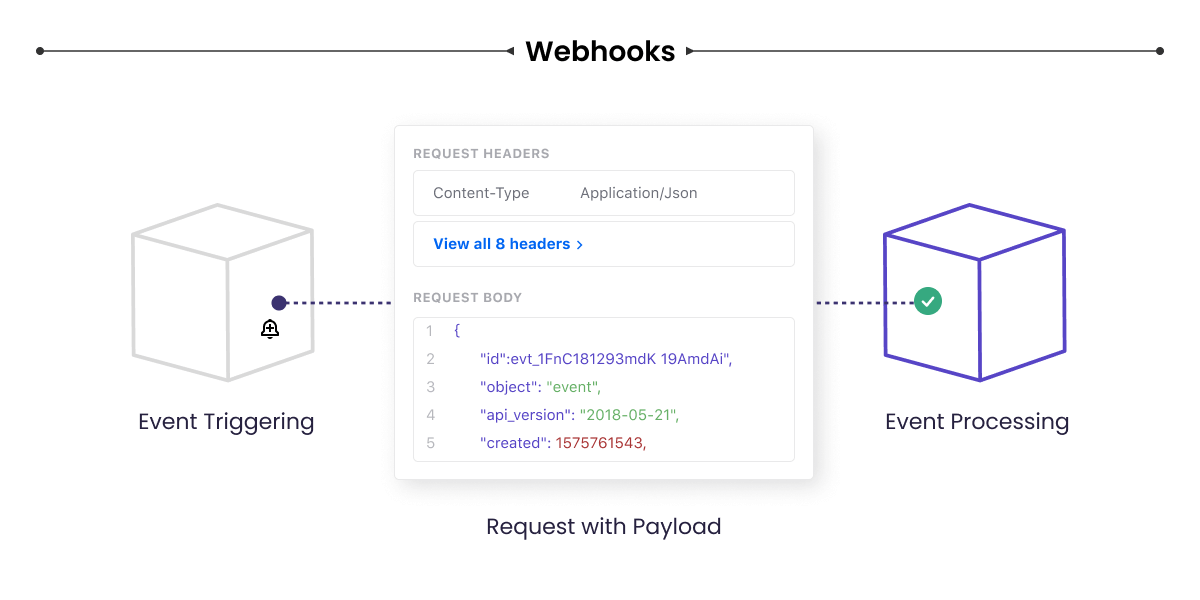
Why are WebHooks important?
Webhooks are known to be called ‘user-defined callbacks made with HTTP.’ They are data, and executable commands are sent from one application (source) to another (destination) over HTTP instead of through the command line on a computer, formatted in XML, JSON, or form-encoded serialization. Webhooks are software hooks, or functions that run when something happens or an event gets triggered, that work over the web. And they are typically secured through obscurity – each user of an application gets a unique, random URL to send webhook data to – though they can also be optionally secured with a key or signature.
Webhooks are crucial because they provide users with efficiency an ETA (Estimated Time of Arrival) management. Here are some reasons why using webhooks is essential:
-
- Update membership lists seamlessly.
Webhooks help you update the membership records of customers to the membership management software you use whenever your customers make subscription payments. Webhooks automate the membership management process, which frees you from the labor of manually monitoring and updating your subscriptions periodically. The payment platform sends the customer details to the membership management app.
-
- Save your work and time.
Webhooks help you save time by communicating with other apps to alternate processes. They notify your Customer Relationship Management (CRM) software whenever a customer subscribes. Moreover, they also help you to sync changes, such as when a customer alters their email address.
-
- Connect payment getaways to your email address
There are numerous online payment gateways available, and most use webhooks rather than APIs Webhooks will send information from the payment gateway to your email address to notify you of the payment information. An Application Programming Interface (API) is a software interface that acts as a link between computers and applications, while a webhook is a way for one app to deliver data to another app in real-time.
Conclusion
In today’s world, information rules the internet. Getting data in real-time makes online services more efficient and appealing to customers’ needs. Webhooks, in this case, offer an automated, non-complex way to make sharing information in real-time possible amongst online platforms. Learn more about webhooks today, get in touch with us.