

Table Of Contents:
1. E-commerce
2. OTA (Online Travel Agency)
3. BFSI
So far email has been the most sought-after medium among businesses to seek feedback, particularly the NPS survey. It would nevertheless continue to be a potential choice.
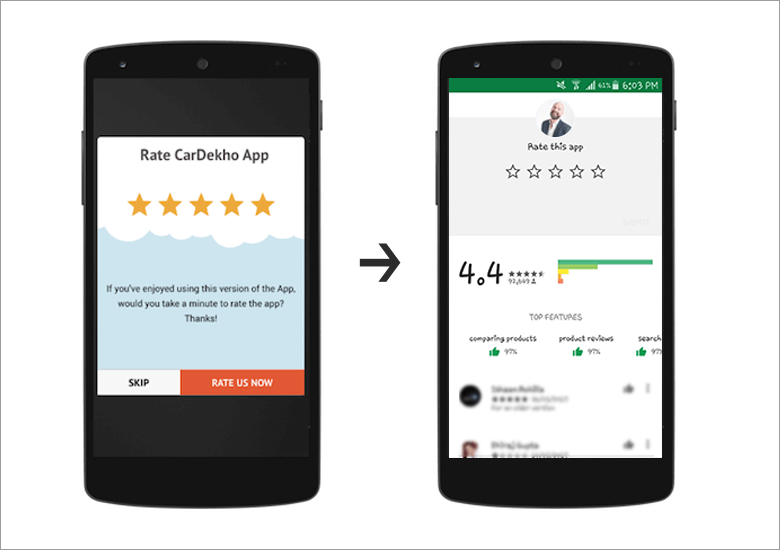
Following email popularity is in-app messages which are part of the UI of almost every mobile app. Publishers insert in-app messages within the user flow to run notifications and surveys of various kinds. The most popular use-case being triggering an in-app message before the nudge to rate the app on play store.
Now did you know that you could use push notification as well for collecting feedback? Strangely, not many mobile marketers have explored the idea of conducting feedback survey via push notification despite it offering the following leverage over the other two channels:
- Push notification has a higher average CTR than email
- Popping an in-app message only to request feedback is damaging to UX. Also, the results wouldn’t be totally reliable as the user’s rating will be highly influenced by his current behavior.
- Seeking feedback response in real time cannot be achieved via email or in-app.
If you too are one of those marketers who hasn’t considered push notifications to drive user engagement plus a potential alternative for collecting feedback, this post is for you.
Recommended read: A Definitive Guide To Understand How Web Push Notifications Work
In this article, we will discuss three use cases across three different industries regarding how marketers can collect user feedback via rich push notifications.
1. E-commerce
Use-case- Take feedback on the purchased product
Journey-
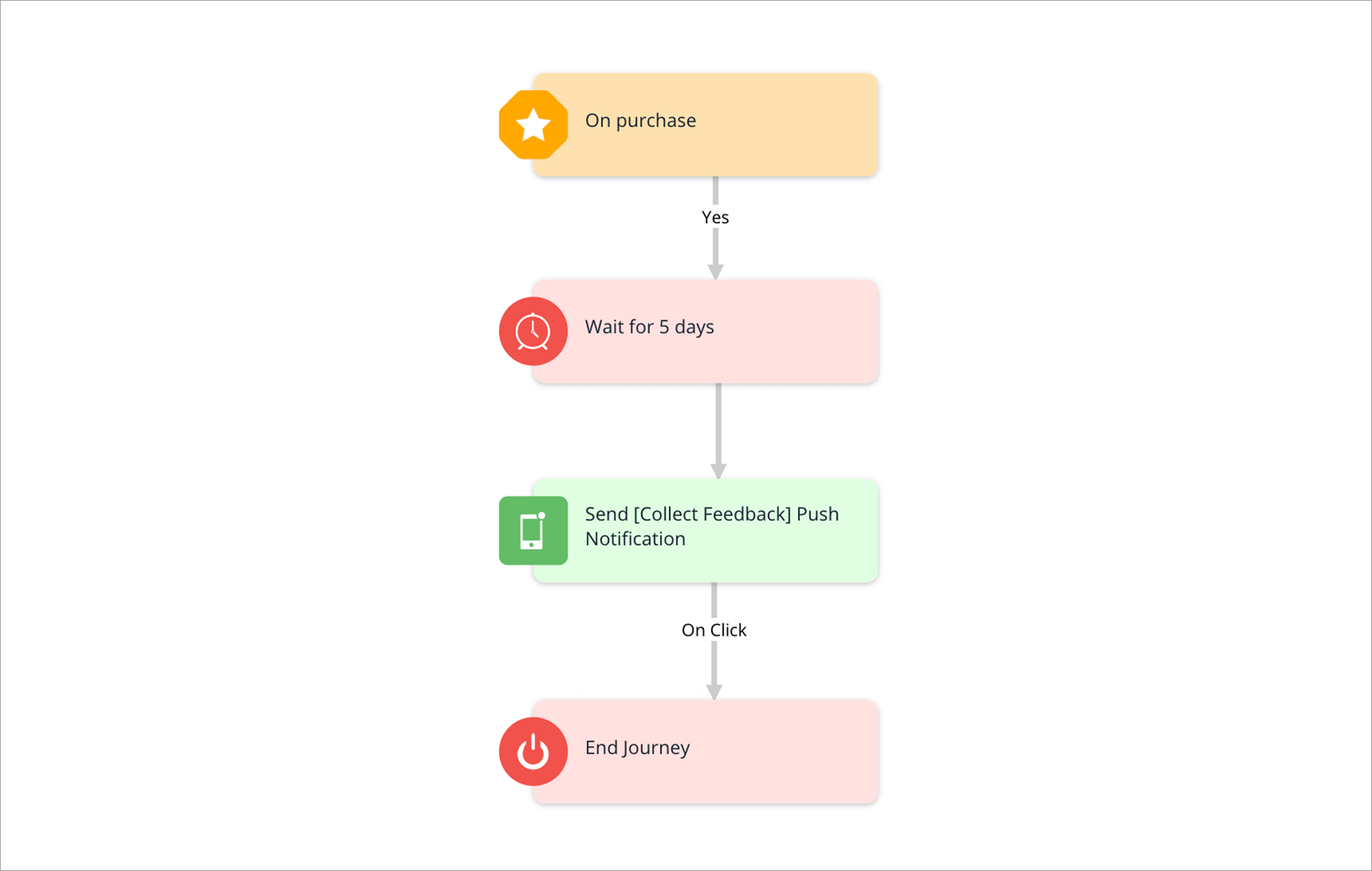
Above is the image of Journey Designer inside the WebEngage system. Journey Designer is a drag-and-drop workflow builder that lets you automate engagement throughout the customer lifecycle across multiple channels.
As it is quite evident, in the above journey(workflow) we are triggering the feedback push on the delay of 5 days after purchase.
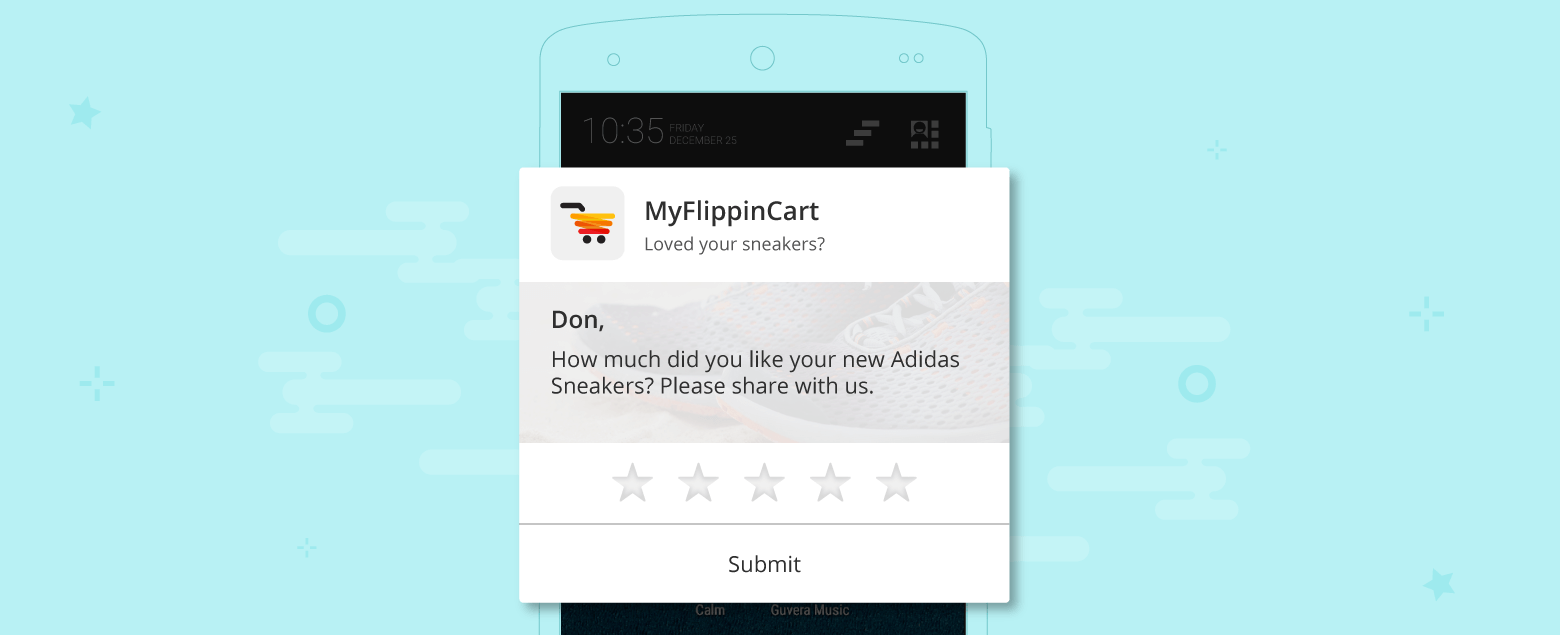
Once the campaign has been triggered evaluate the response of your users. Lifting the snapshot of UI from the WebEngage dashboard.

How to Use Push Notifications for Customer Feedback in E-commerce?
To use push notifications for customer feedback in e-commerce, follow these steps:
- Integrate a push notification system into your e-commerce platform.
- Trigger notifications post-purchase to encourage feedback.
- Include a direct feedback link for seamless access.
- Personalize messages to enhance user engagement.
- Monitor and analyze feedback data for continuous improvement.
2. OTA (Online Travel Agency)
Use-case- Take feedback on the stay experience
Journey-

In this Journey, we send the feedback push after two days to gauge the stay experience. Further, after 10 months, we check if the user has made a repeat purchase or not. If he has and the response is positive then we push him another notification and offer an incentive to nudge him for repeat purchase.
On the flipside, if he hasn’t made any new purchase then we push him to another nurturing journey which is a subject of another article altogether.

Benefits of Push Notifications for Feedback in OTAs?
Push notifications offer several benefits for collecting feedback in OTAs, including:
- Timely communication
- Convenient interaction
- Enhanced user engagement
- Improved customer experience
- Valuable insights for the platform
3. BFSI
Use-case: Take feedback on the purchase experience and the financial product purchased by the user
Journey:
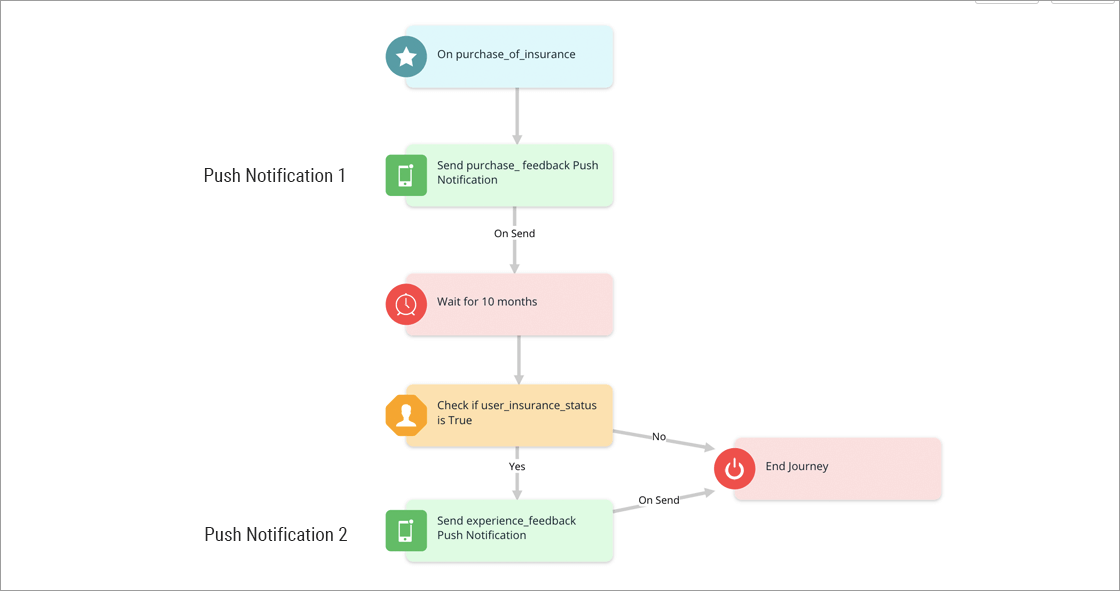
BFSI products have relatively longer sales cycle and shelf life. So the experience of the user is a mix of two components- a) his experience making the purchase b) his experience using the product that they purchased.
With this Journey, we have tried to glean feedback for both the events via push notification.
[Push notification 1] After 5 days- to gauge the experience doing business with you.

[Push notification 2] After 10 months- to know his experience with the product they bought.

Effective Push Notification Strategies for BFSI Feedback?
Some of the effective push notification strategies for BFSI feedback are
- Target specific customer segments with personalized feedback requests.
- Use push notifications post-purchase or after specific banking transactions to capture feedback.
- Offer incentives or exclusive offers to encourage users to provide feedback.
- Incorporate feedback loop into product development and customer service processes.
Recommended read: Push Notification Best Practices
Conclusion
Back in 2015, Techcrunch published an article that notifications are next platform amid the discovery model transitioning from pull to push driven.
Do read that article. It’s surely worth your time
Notifications Are The Next Platform
But simultaneously the opt-out rate of push has also been surging. And the problem here is once the user revokes the push permission, the arduous UI will ensure that it is never restored again. So, the job of the marketer is to judiciously leverage this medium which is possible only if you push notifications that help. Hope the use-cases mentioned above helps.
FAQS
How can push notifications be used to collect customer feedback in e-commerce?
For feedback collection via push notifications, businesses must prompt users to rate recent purchases or experiences to get valuable insights. You do it via clickable survey links or quick-response options.
What are effective push notification strategies for OTAs to gather feedback?
Some effective push notification strategies for OTAs are
- Sending targeted messages post-travel
- Encouraging customers to leave feedback
- Offering incentives or season deals
- Creating simple and user-friendly feedback forms
- Sending push notifications at optimal times
How does the BFSI sector benefit from push notification feedback?
In BFSI, push notifications help in collecting timely customer feedback. Questions can be about transactions, service quality, or new features in the feedback form. These timely alerts allow customers to report suspicious activities promptly.
What makes real-time feedback collection through push notifications effective?
Getting feedback quickly is really important for banks and insurance companies. With push notifications, they can ask customers questions right away. This means customers can give their opinions right when they’re asked, giving the banks and insurance companies important information right away.
Bonus Read – 6 Unique Push Notification Use-cases For E-commerce Apps