










Summary
Flytoday partnered with WebEngage to build a funnel-aware automation engine across booking recovery, customer reactivation, and travel cross-sell.
- Identified drop-offs and dwell time across key booking stages.
- Segmented early and late bookers, high-value dormant users, and churn-likely customers.
- Built contextual journeys for conversion, reactivation, and cross-selling.
- Used SMS, Push Notifications, Web Push, and Email with frequency controls.
- Measured channel contribution and ROI through control groups and multi-touch attribution.
Turning Booking Intent Into Measurable Growth
Flytoday saw customers search, compare, and leave at different stages of the booking funnel. Repeat customers also remained inactive despite having previous purchases and unredeemed loyalty points.
The opportunity was to connect behavioral data, segmentation, journey execution, and revenue measurement within one engagement model.
WebEngage Solution
WebEngage helped Flytoday create product-specific journeys around customer behavior and travel intent.
Customers were segmented across three key dimensions:
- Travel timing: Early and late bookers
- Customer value: High-value dormant users based on past trips, cart value, and loyalty points
- Product intent: Customers booking flights or hotels without exploring related travel products
These segments helped Flytoday determine which journey, message, and channel was most relevant.
The engagement model covered:
- Early flight-booker journeys for short-haul and international travel
- Reactivation journeys for high-value dormant users
- Cross-sell journeys for tours, holiday bundles, and destination offers
- SMS, Push Notifications, Web Push, and Email
- Frequency capping and Do Not Disturb windows
- Control groups and multi-touch revenue attribution
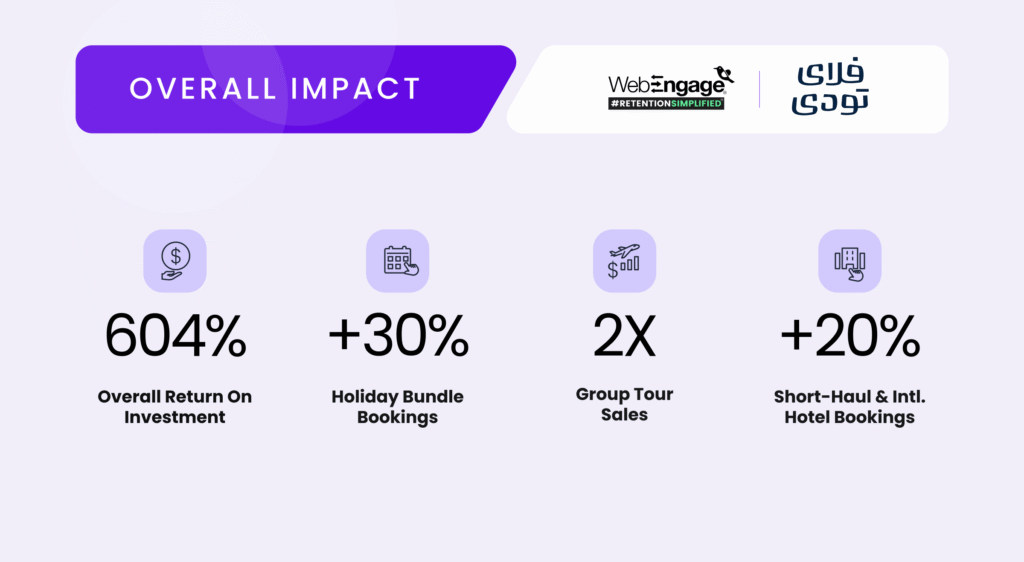
The Business Impact
Flytoday recorded strong outcomes across conversion, product sales, channel contribution, and overall ROI.
The Bigger Picture
Flytoday created a funnel-aware engagement model built around booking stage, travel timing, customer value, and product interest.
Booking drop-offs became easier to identify and address. Dormant customers could be reactivated using purchase and loyalty data. Cross-sell journeys connected completed bookings with relevant travel products.
This created a repeatable framework for expanding personalized journeys, controlling communication frequency, and measuring revenue contribution across channels.