
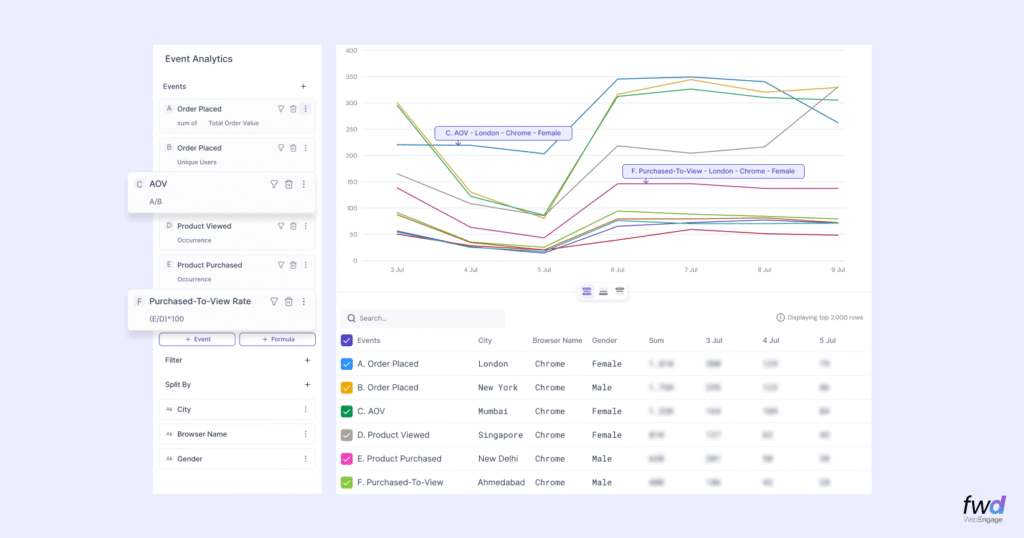
Give the increasing usage by the product and growth teams, we are delighted to introduce a whole set of new additions to our Event Analytics and Funnel modules.
While using our Event Analytics module, you can now add multiple events and splits across multiple attributes – all visualisations presented in the same viewport as shown below. Did you notice that you could use multi-splits with Formula based metrics too?
While analysing your Funnels, you can now switch seamlessly between Uniques or Occurrences depending on the question you are trying to find an answer for. Also, you can now compare your funnels across time period – current vs last month etc.
The key addition is Context Aware Funnels!
Did you know that when you look at event based funnel in any tool, there’s no context carried forward at each step? Well, say you have a funnel Product Viewed -> Added To Card -> Product Purchased. Any user who does all these three events in that sequence is a “converted” user. No matter which product they dealt with at each step of the funnel. Our context aware funnels solves this for you (example shown below).
Salla is one of the largest commerce platforms in the GCC region built specifically for merchants in the Middle East with native support for Arabic, local payments, shipping providers, VAT requirements, and regional commerce workflows. In a big news for Salla merchants, today we are stoked to announce the WebEngage Salla native integration. It is now live on the Salla App Store, and just one click away from installation. Salla merchants can now transform their customer and store data into intelligent and personalized customer experiences unlocking engagement across 15 channels with zero engineering effort!
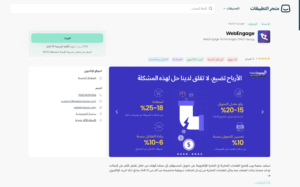
With WebEngage, Salla merchants get to put their store data to use. All signals including customer’s behavioural footrprints, transactions, store’s catalog, lapsed customers etc, are tracked in realtime. The WebEngage platform puts this data to work by helping them build intelligent segments and delightful customer journeys. This native integration unlocks 3 capabilities for Salla merchants on WebEngage – get a ready Customer Data Platform (CDP), a multi-channel Customer Engagement Platform (CEP), and a full blown Analytics Suite.
Last year, we launched a composable version of our Customer Data Platform, CDPx and introduced Entities – a simple way to house data pertaining to customer relationships in WebEngage so that you could use it further for your customer segmentation and lifecycle campaign orchestration.
Since the launch of CDPx our customers across multiple verticals including Financial Services, Healthcare, Automobile, Consumer Durables etc, have started structuring their customer data in the way their business actually works. And that’s when a common challenge surfaced; the more entities and relationships they wanted to bring inside WebEngage, the harder it got to manage what connects to what.
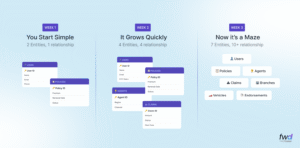
Today, we’re thrilled to introduce the Entity Relationship Visualizer – a visual, interactive canvas that lets you manage your custom entities and their relationships. You can see all your entities, their attributes, relationships, on one screen. All connection between entities display the associations (as verbs) that define their relationships (e.g., “belongs to”, “purchased by”, “raised by” etc) and show their relationship cardinality (e.g., many-to-one, one-to-many, or one-to-one etc).
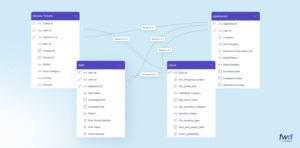
In the visualization above, you can immediately infer that a User may purchase many Appliances with AMC Contracts. A User may create multiple Service Tickets against an Appliance that the User owns.
We are introducing a new and an all powerful successor to the our role based access controls (RBAC) in WebEngage – its enterprise grade variant based on object based access controls (OBAC). Enterprises that use WebEngage across geographical boundaries, or have multiple lines of businesses (LOBs) or those who have their operating teams split by Brands or Functions have often asked us about separation of their customer data in a manner that each of these teams ONLY see and act on customer data that is relevant to them. Today, we oblige. Say hello to WebEngage Teams!
With Teams, you define data boundaries for your organisation. Think of Teams as a persistent filter that defines which users data a team member can see while using different sections of the WebEngage Dashboard.
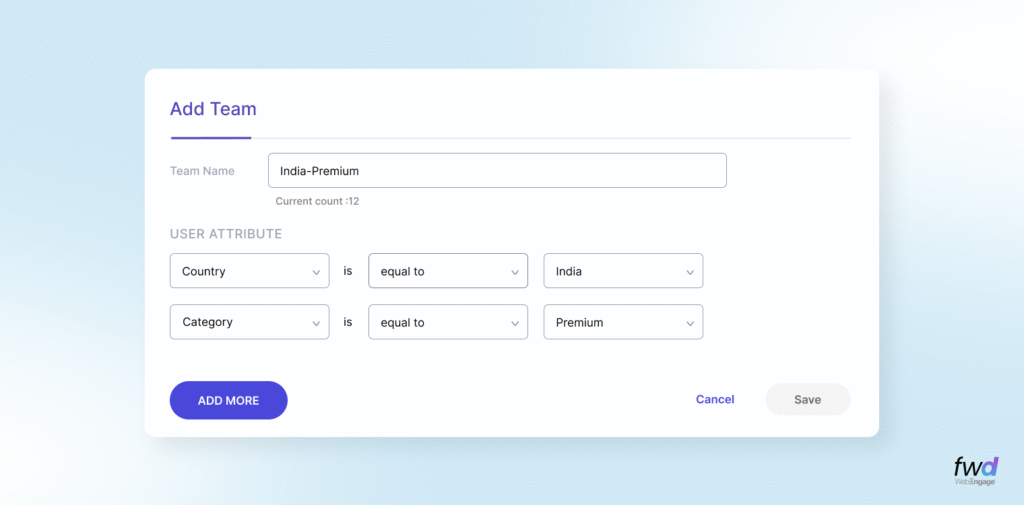
For example, you could create a Team called “India Premium” that only includes users where Country is India and their Tier is Premium. Once you assign this Team to a marketer, their ENTIRE WebEngage Dashboard experience changes. They’ll only see users, segments, campaigns, analytics, that fall within that boundary definition.
Every user has preferences. The movie genre they always come back to. The product category they browse unprompted. The cuisine they default to when they’re ordering for themselves. As a growth marketer, you’ve always known these preferences in the form of user intent (aka, affinity) exist, and you’ve always wanted to act on them. Yet, you had to wage wars to even get remotely close to doing it right. Suffer no more. We are stoked to unveil WebEngage’s legendary Affinity function!
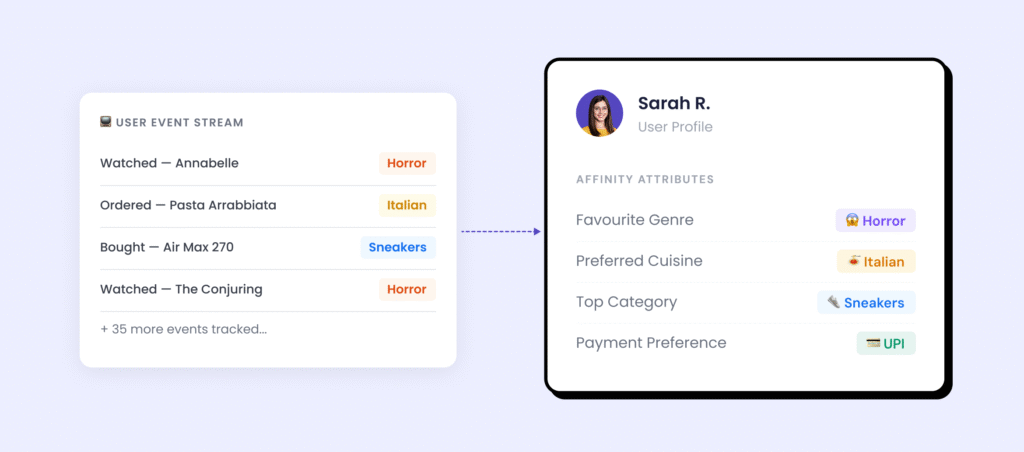
Affinity joins our growing list of aggregation functions in Derived Attributes such as Sum, Average, Max, Min, Count, which all operate on numeric data. They can tell you how much someone spent, how often they opened the app, or what their highest single order value was. But none of them can tell you what a user PREFERS. That requires a different kind of capability, and that’s exactly what Affinity is built for.
You can use these Affinity function based derived attributes across our Segmentation, Personalisation and Analytics modules.
Our CDPx now has a rule-cum-heuristics based deduplication engine that allows you to merge duplicate user profiles on the go!
Thanks to multiple workflows and touchpoints in businesses, their user data streams are almost never coherent across data sources. And this trickles downstream to systems, including WebEngage. A user signs up on your website, downloads your app, walks into your store, and more often than not, you’re looking at three “different” users in your system who are actually one.
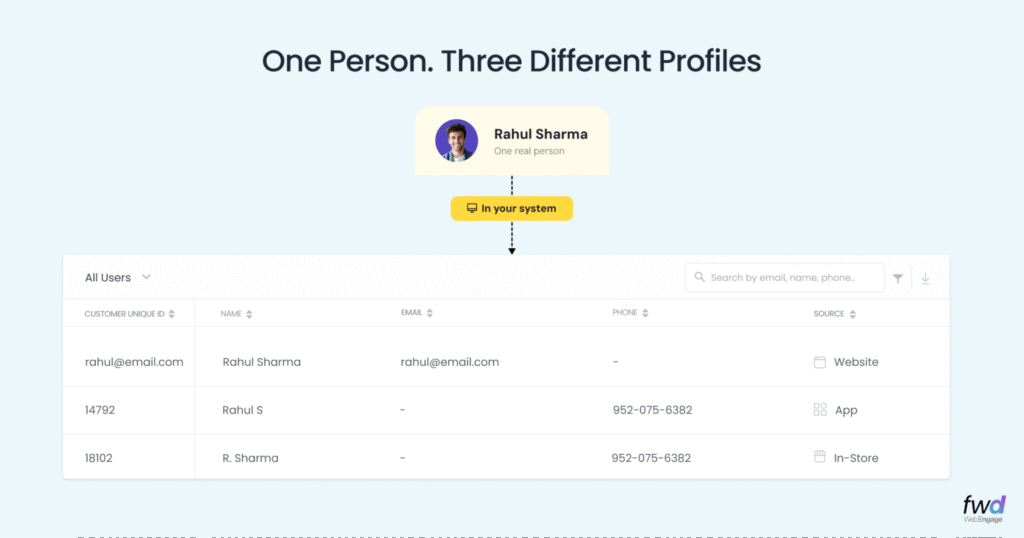
re excited to launch Intelligent Deduplication – a powerful capability that identifies duplicate user profiles, and merges them into a single record (the Golden Record, if you will). No more messy ETLs and data pipelines. Just a clean data room with unified view of every user.
Derived Attributes are a realtime DIY data pipeline in WebEngage that allow you to create auto refreshing user attributes based on existing events (user actions) and user data (your first party data stored in user profiles). Think of them as smart, dynamic attributes without the hassles of creating and maintaining a compute pipeline.
Unlike standard attributes that you pass via SDKs, APIs or Other Integrations, Derived Attributes are created, computed and stored directly from within the DIY WebEngage Dashboard,. It uses your existing data as the foundation.
This feature is a solid addition to our current set of derived feature sets – be it the Engagement Score feature for lead generation business, or, the Intelligent Attributes (such as best channel for a user, best time to send campaign to a user etc), or, the recently launched Affinity() function for intent based segmentation.
Other than building precision Segments, Derived Attributes could be used to run highly relevant product recommendations as shown below.
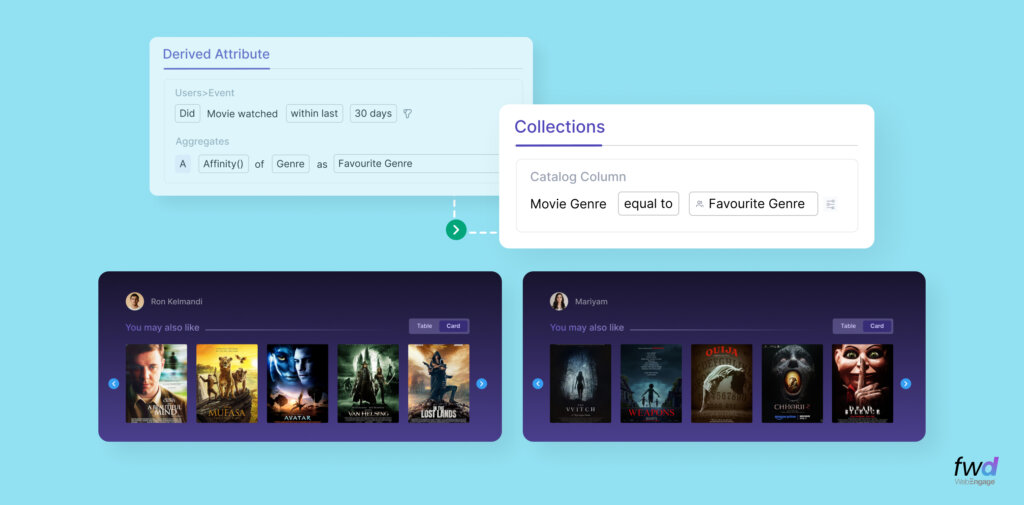
Derived Attributes bridge the gap between raw data and instantly actionable data. No more manual calculations, no more external processing, no more stale metrics. Your user profiles are now way more enriched than ever before and reflect real-time aggregations.
Our agents are designed to be your co-pilots and assistants, helping you move from idea to execution in minutes, instead of hours or days. We are touching all aspects of your everyday work in WebEngage with these agents – be it analyzing campaign metrics with deeper insights, or building a new customer segment, or creating new campaigns/journeys – you don’t have to spend time on the grunt work anymore.
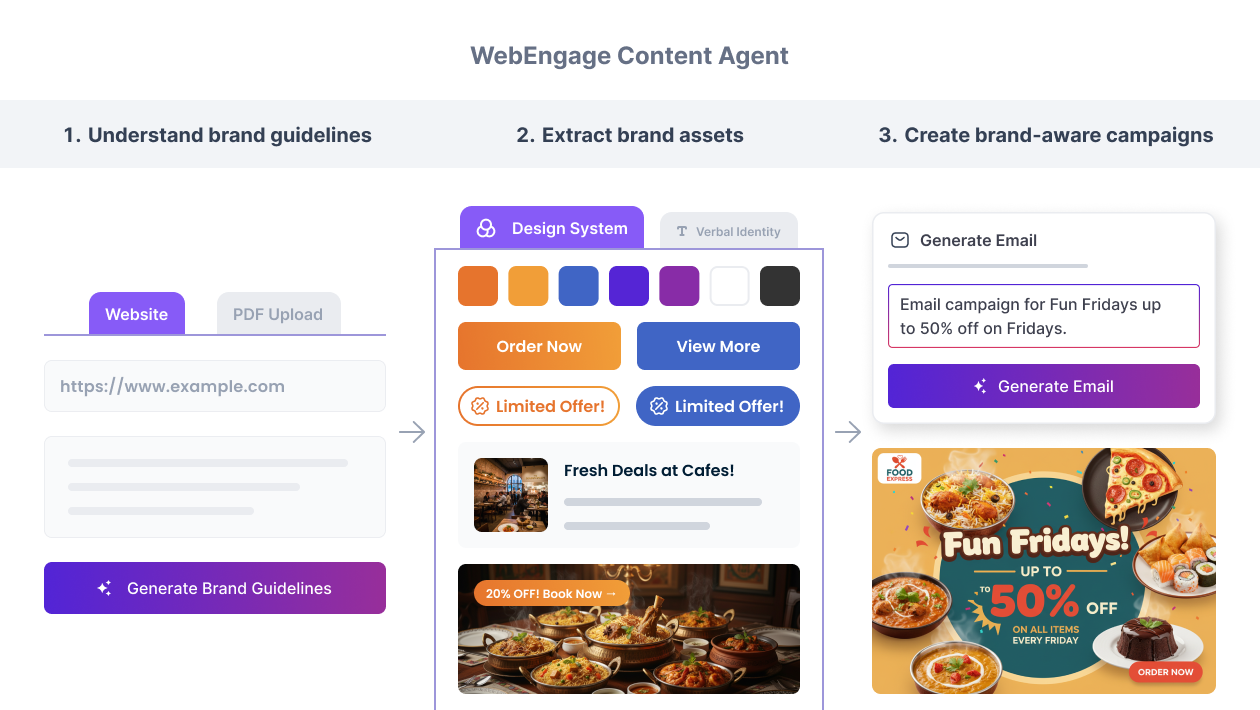
Today we are proud to unveil these agents which will act as your co-pilots for all your day-to-day tasks on WebEngage..
- Insight Agent – Don’t just look at your campaign metrics, uncover deep insights behind every data point
- Segment Agent – No more of trying to figure out the right events, attributes and their combinations for your use-case
- Content Agent – Create context aware content that adheres to your brand guidelines; on-demand!
- Journey Agent – Build full journeys over a prompt. This one’s too good to be true!
If you have used our widely popular Web Personalization product suite, you have most likely asked for these enhancements in some form..
- Make the editor more DIY to create ultra rich looking nudges and overlays
- Provide a way to directly enrich CDP User Profile of the user engaging with your overlay using data collected (for overlays with forms) from them in realtime
Well, we obliged 🙂
The core of our new release is the Drag-and-Drop Editor. You no longer need to know HTML or CSS to build beautiful, branded overlays. Simply drag elements like headers, images, buttons, and timers directly onto the canvas. What you see is exactly what your visitors will get.
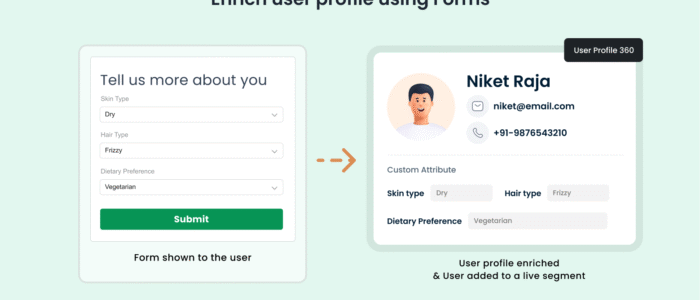
With our Form Support, you can drag input fields directly into your notifications. Capture emails, phone numbers, or even zero-party data like product preferences (e.g., “What skin type are you?”). This data isn’t just stored; it enriches the user profile in real-time, fueling your downstream personalization strategies.
Different tools in our category do this differently. While some would deny you the privilege outright leaving you with no choice but to stop/sunset an existing Journey and create a new one; others who claim to let you do “edits in a live Journey”, actually create newer versions which is no different than sunsetting the exiting Journey and creating a new one – current users in your Journey will never get to benefit from the improved logic that you are about to incorporate in your newer version. We decided to change that and implement what’s been on our wishlist for a long time – say hello to Customer Journey Live Editing in WebEngage!
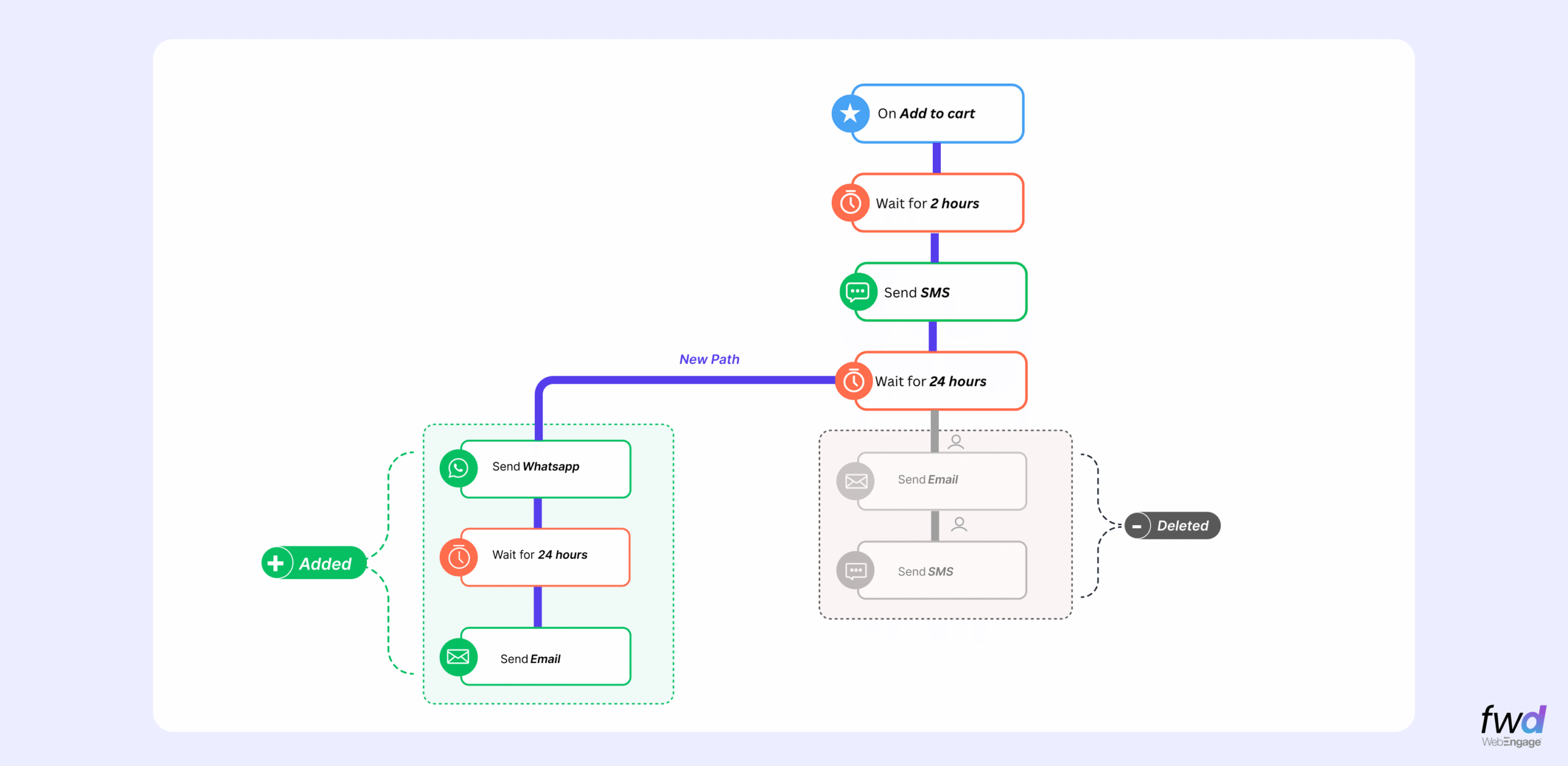
Experiment on your active Customer Journeys with our live editing feature without having to stop/sunset your existing Journey or create a new versions every time.
Only on WebEngage!
Because great ideas need to be painted a great canvas 🙂
High quality User Segmentation sits at the heart of every marketing and product decision. Even more so, if you are a MarTech practitioner on products like WebEngage. From being a simple criteria builder in our very early days, to demographic segmentation engine, to predictive segmentation, and now all the way towards psychographic segmentation – we have evolved with you in this journey. On that path, we decided to relook at the experience of building Segments. And, we rebuilt it from the ground up.
Say hello to a clean, unrestricted Segmentation Canvas
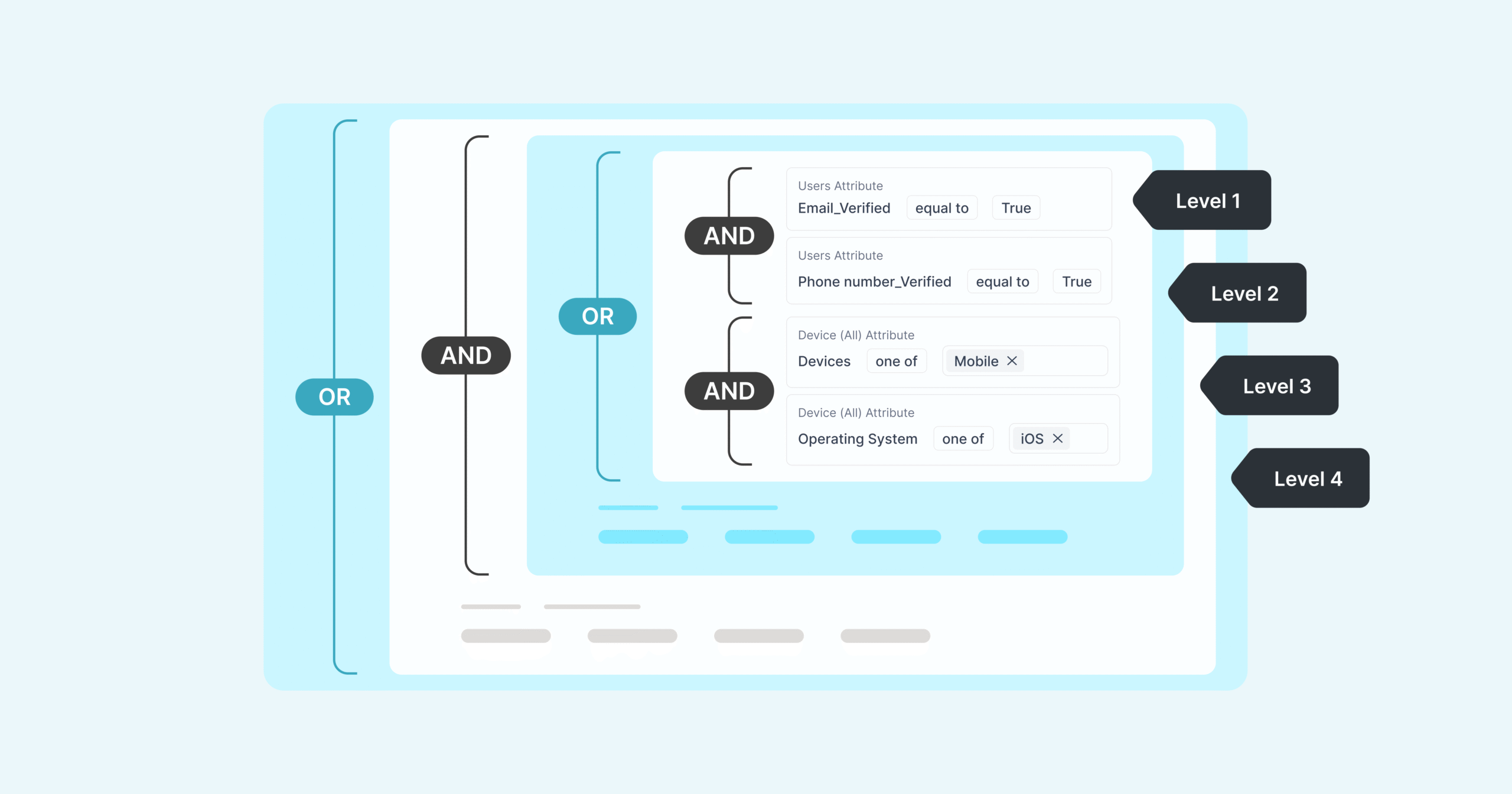
With a clean canvas, flexible criteria builder, nested logic, derived attributes, and affinity functions, Segmentation in WebEngage is the new gold standard in all modern day CDP/CEP products. We have just unveiled the most powerful Segmentation Engine ever seen in our category.
Most Recommendations are either too generic (Top Items) or too opaque (Personalised). And more often than not, marketers find themselves looking at their recommendation widgets thinking: “This doesn’t feel relevant. And I can’t even explain why it showed up.” While both, Top Items and Personalized Recommendations are useful in their own way; they miss a core theme – they aren’t context-aware. Personalized recommendations excel at behavioral patterns, but they’d deliver the same results whether it’s Arjun in Mumbai or Simone in London. Collections makes your Recommendation location aware in this case. With Collections, you’d be able to recommend “popular items” in e-commerce with range filters in a certain geography or “popular restaurants” in a certain area or “coupon codes you can redeem at shops near you”.
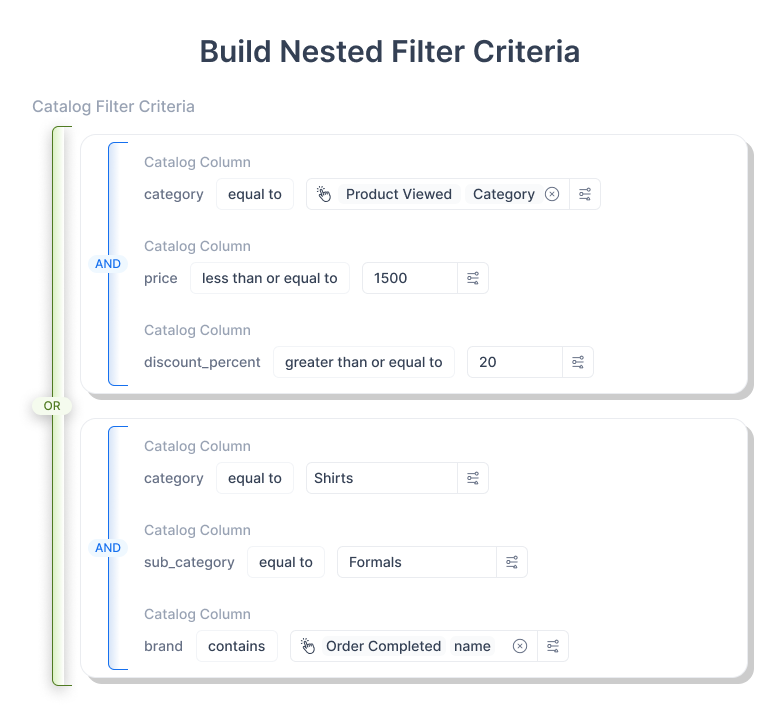
Collections is a real-time curation layer that works alongside your existing recommendations. While Top Items and Personalized Recommendations continue driving discovery and behavioral patterns, Collections adds campaign-aware, context-driven control to your recommendations.
Everything you wish to know about user behaviour starts with Event Analytics. We have rebuilt Event Analytics for teams that want to dig deeper, compare smarter, and answer questions faster. The new experience unlocks these capabilities for you…
- Split your analysis by event or user attributes; compare these splits side-by-side in the same viewport
- Choose flexible reporting windows (and presets); compare with a similar period in the past
- Pin and Monitor any metric on the Event Analytics screen to your daily Dashboards
- Say hello to Formulas
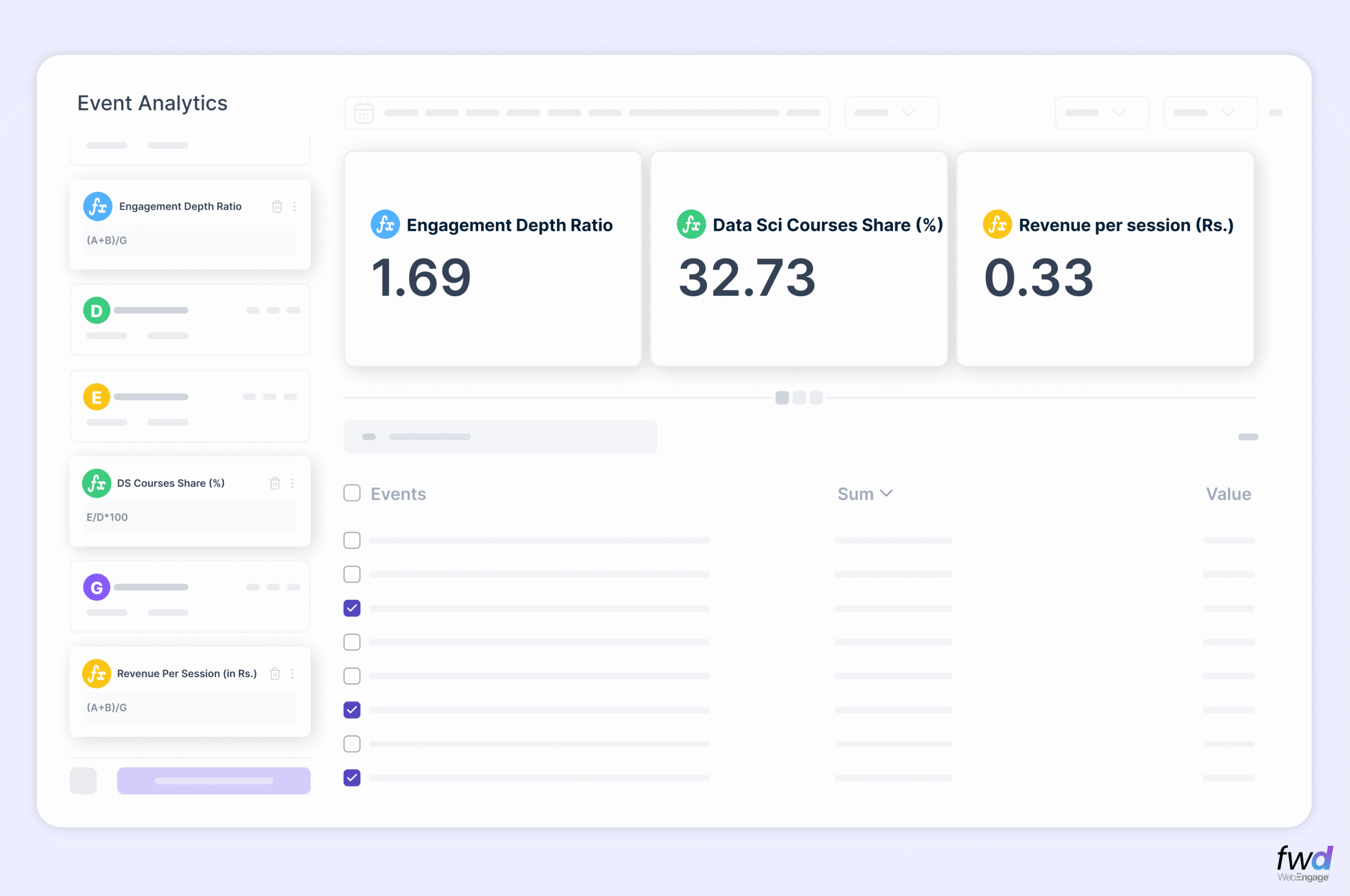
Forumlas help you create a completely new business metric using aggregates and derivations. You can now easily measure and monitor metrics like Average Order Value (AOV), Lifetime Value (LTV) etc.
Most CDPs stop at users and events. Real businesses do not. They operate around objects like policies, loans, devices, subscriptions, or courses, each with its own lifecycle and logic. CDPx extends WebEngage’s CDP to model these real-world objects natively, connect them to users and events, and enable truly contextual engagement at scale.
What’s New
- Custom Entities Create and manage real business objects such as Policies, Loans, Devices, or Courses directly inside WebEngage.
- Lifecycle Awareness Entities can hold states like Active, Lapsed, Due, or Overdue, allowing campaigns to react as records change over time.
- References Link Entities to Users, Events, and other Entities
- Segmentation Enhancements Build user segments using entity data, for example users with more than two active policies. You can also segment entities themselves, such as all policies expiring in the next 15 days.
- Personalization Use entity attributes directly in campaigns.
- Entity Navigation Entities appear as tabs on the main menu and inside user profiles, showing linked records like a user’s policies with related claims nested inside.
How It Works
- Create an Entity Define the entity details and configure entity schema.
- Set Data Source Choose between static uploads or dynamic sync with configurable auto-refresh.
- Manage References Connect entities to users, events, or other entities to build relational models.
- Use in Segments and Campaigns Filter users or entities, personalize messages, and trigger journeys based on entity attributes and lifecycle states.
Why It Matters
You no longer need to force complex objects into flat user attributes or misuse events as storage. Workarounds and fragmented dashboards are reduced significantly. One user can hold multiple policies, devices, or loans without messaging conflicts. Customers get clearer, more relevant communication through digests and lifecycle-aware campaigns.
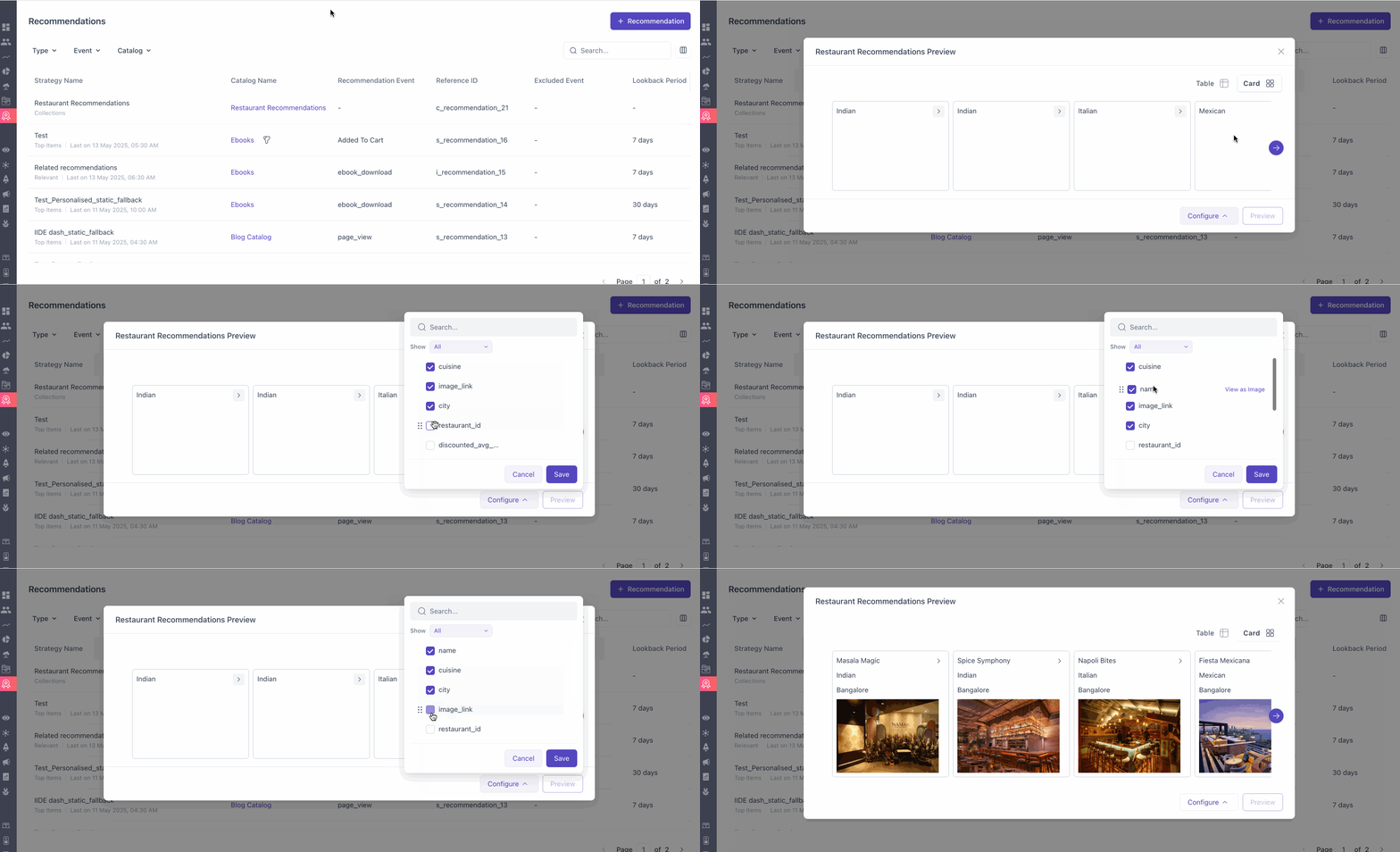
Easily visualize how your users will experience product recommendations with the new Card View feature. This drag-and-drop layout lets you configure the arrangement of recommendation cards just the way you want them to appear. You can map specific catalog fields as image links, giving you full control over how visuals are displayed. Each card is expandable, allowing you to view important metadata like the strategy type, recommendation source (primary or fallback), and reference ID for tracking. Your configurations are saved locally per recommendation in the browser cache, so you can revisit and tweak layouts without starting from scratch.
Note: Since these settings are stored locally, clearing your browser cache will reset your saved card layouts.
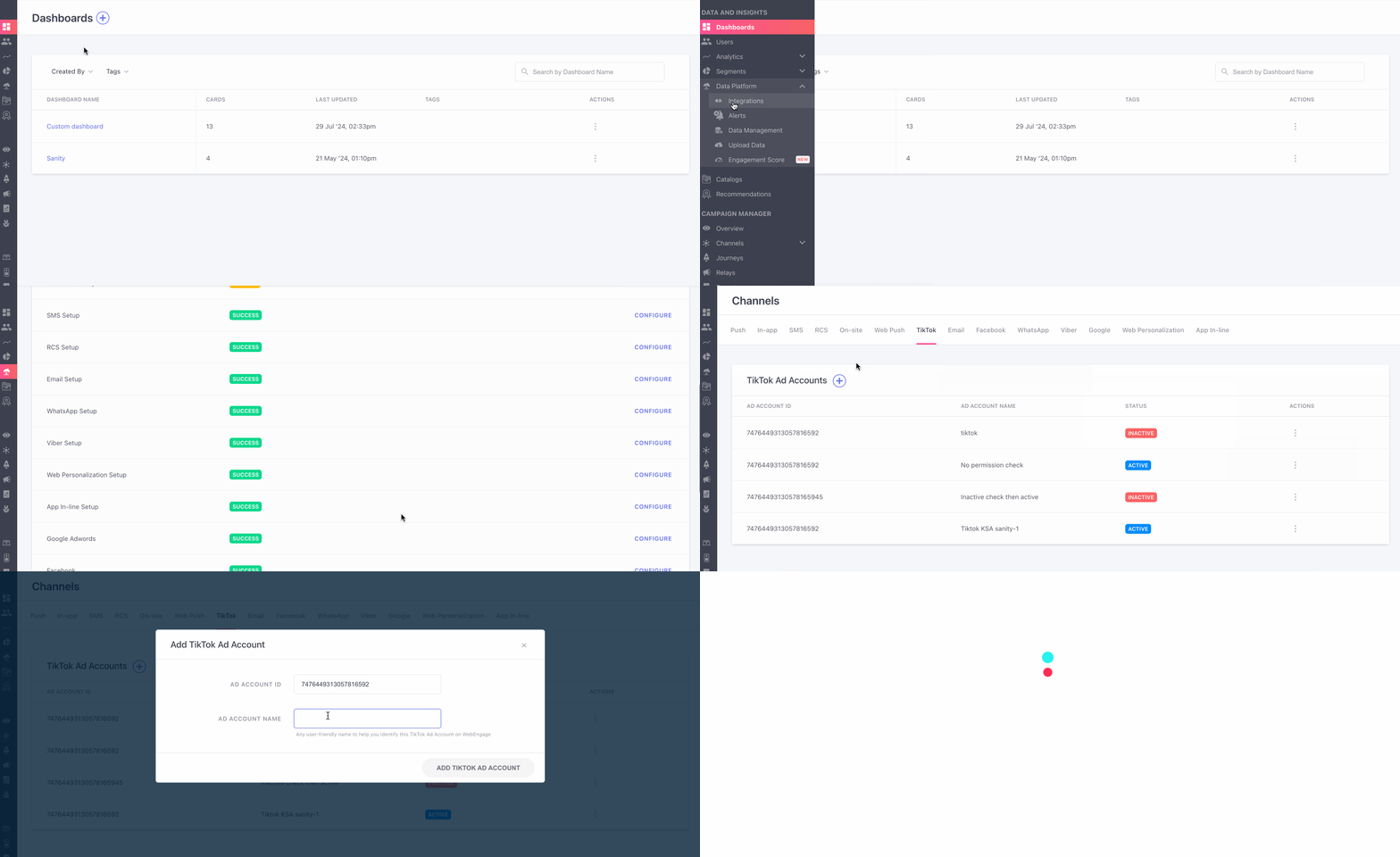
WebEngage now integrates with TikTok Ads Manager for precise ad targeting, leveraging its vast and engaged user base, especially in key regions. This extends our ad ecosystem beyond Facebook and Google, offering benefits like direct segment syncing for personalized ads, improved performance via first-party data, and seamless automatic updates. Note: Access requires enabling the WE_TIKTOK_EXPORT flag (contact support) and referring to the KB documentation.
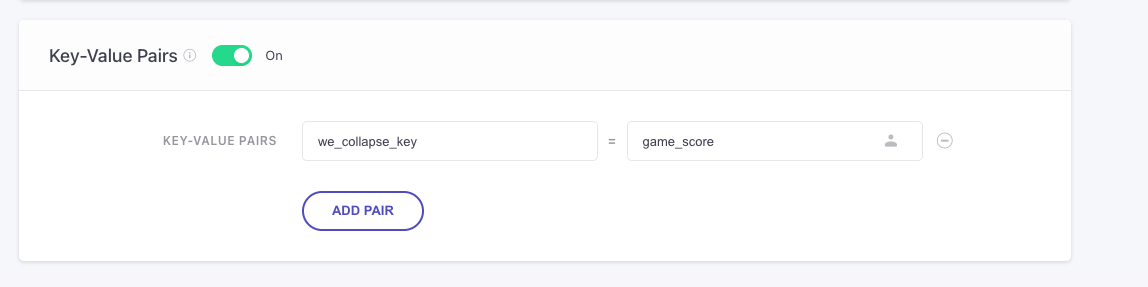
Streamline user experience with the push notification collapse key: a unique identifier (we_collapse_key) that ensures only the latest relevant message is displayed by replacing older notifications with the same key. To use, enable Key-Value Pairs and assign we_collapse_key a unique value (e.g., “order_update”, “flash_sale”, “live_class”). For instance, instead of multiple order status updates or a series of flash sale inventory alerts, users see only the current information. Similarly, webinar reminders are consolidated to the most timely one. Supported on Android (4.18.1+) and iOS (6.15.0+); see KB documentation for setup.