

Scenario 1: Your girlfriend has abandoned you. You want her to come back, and you text her to please return.
Scenario 2: Your girlfriend is in the process of abandoning you. You don’t want her to leave. You act, try to make her stay; then and there.
For the sake of understanding, the two scenarios illustrate apt analogies for the approach e-commerce sites take to tackle cart abandonment.
Just that here the girlfriend is a prospective buyer, and you are a seller.
I will keep it simple, scenario 1 is for cart abandonment emails and scenario 2 is for checkout exit overlays.
Let’s Talk Numbers
Cart Abandonment is an opportunity disguised as a challenge, below are some stats quoted by Business Insider;
- 75% abandon their carts on average across eCommerce sites – that’s 3 in every 4 potential customers that will leave your checkout without paying
- 63% of these carts were suggested to be recoverable – that’s a mind-blowing amount of e-commerce sales that could potentially have converted into a sale
- 40% open and 20% click-through rate on an average for abandoned cart emails – this is a decent number. But with increasing difficulty in getting noticed in a customer’s inbox, this will become a more challenging method of retention.
So the legend has it that a sales opportunity knocked on your door but, unfortunately, got lost. So what do you do to convert that opportunity into sales? Let’s see.
The clichéd: Cart Abandonment Emails
Cart abandonment emails or shopping cart recovery emails are the reminder emails sent to customers who added products to the cart but failed to buy (checkout).
The basic premise is to capture the consumer’s email within the online checkout and send them a courtesy email to complete the transaction later.
To be able to send this courtesy email the most important thing is to capture the email address of customers. Then other critical things like email subject, body copy, imagery, timing, buying incentive; follow the list.
Even after doing all that, a recovery email might go unnoticed after landing in unimportant email tabs like Promotions or Social. It may also face the possibility of time-lapse, wherein limited period offers get over.
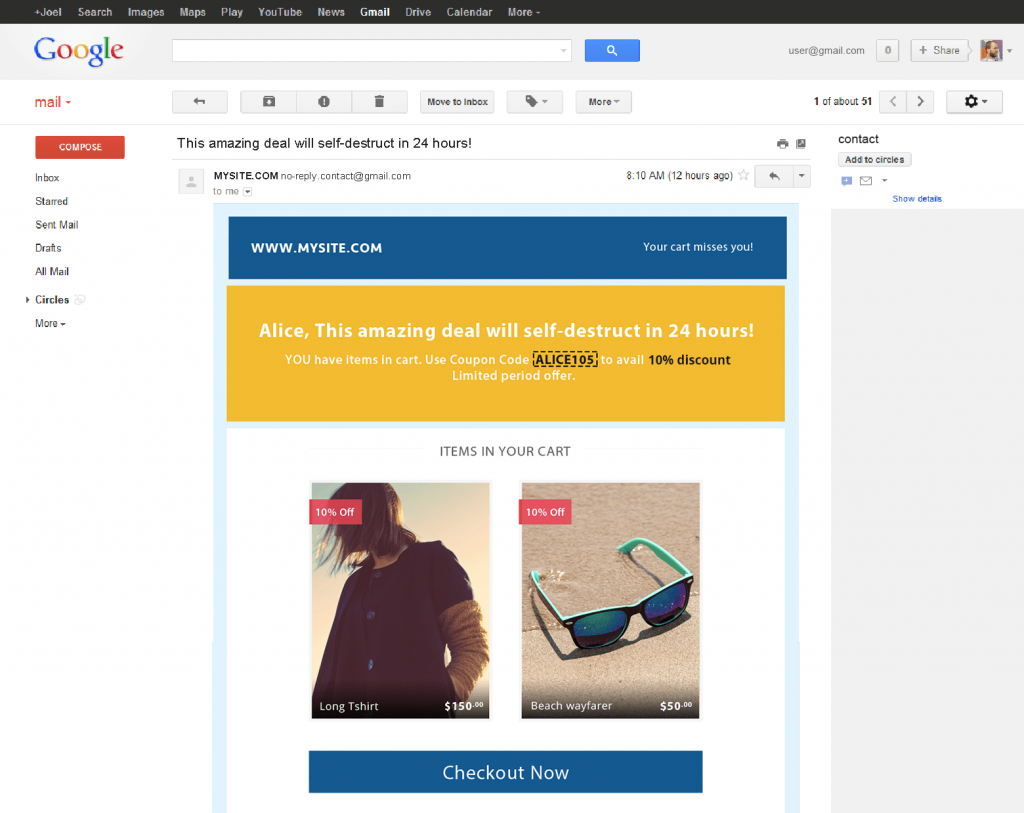
This is how a typical cart recovery email looks like:
But there is a catch when it comes to incentivizing abandoners to purchase by offering a discount via email.
Forbes lists this trick as number 2 in the 10 sneaky online shopping tricks for scoring major discounts.
And this article by www.rather-be-shopping.com shows 17 online retailers who practice giving discounts in recovery email.
The trick is to intentionally leave items in the cart and wait for an email with discounts to arrive in your inbox.
Buyer conditioning, the problem with incentivizing abandoners via shopping cart recovery emails. Watch this old lady give you a tip on saving money while buying online.
The Underused: Checkout Exit Overlays
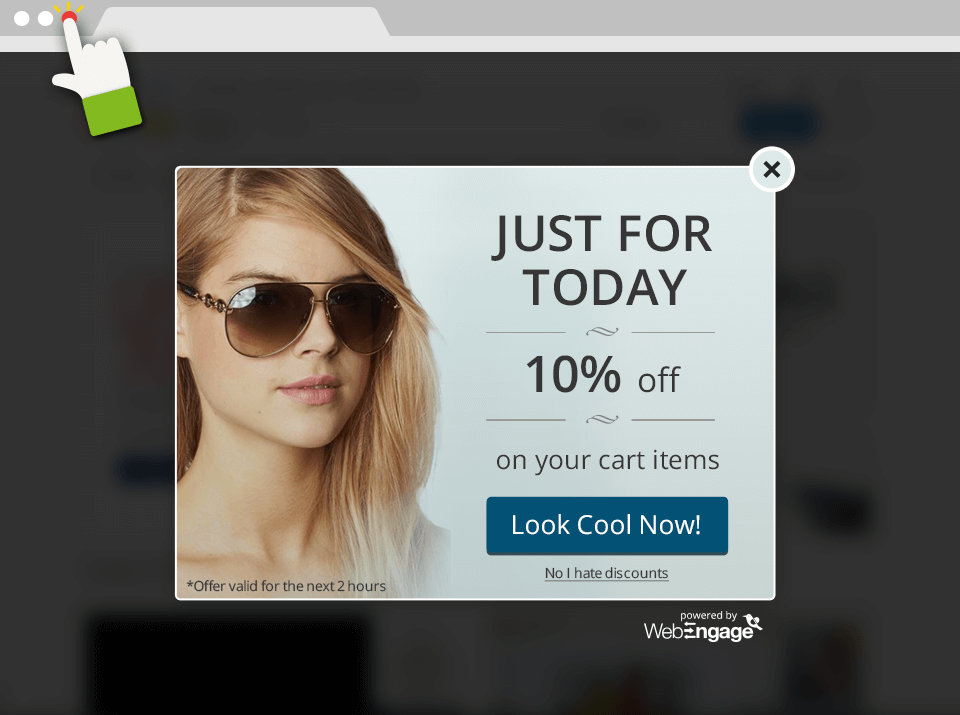
An exit overlay (popup) is a modal notification that opens in the same window the user is browsing and is triggered by the exit intent of the user.
The tech involved here tracks the movement of the mouse cursor. As soon as it reaches to close the browser tab or switch to another tab (an exit intent) an overlay pops up.
The below image depicts a checkout exit overlay(Notice the mouse pointer just about to close the browser tab):
The alternative to an email after the potential customers leave your website is to keep them within the cart or checkout in the first place.
Checkout exit overlays (popups) are extremely useful to help create a virtual sales assistant. To use an analogy from bricks and mortar, the sales assistant is on hand to identify potential customers who may need general or specific help.
Notifications (or exit overlays) can be set off based on various trigger points:
- Source of visit
- Specific campaign
- Whether they’re new or repeat customers
- Number of visits to the site
- Time spent on the site, specific section, or page
- Items viewed or added to cart
The list could go on. Generally, notifications can appear as subtle messages within the page, like header or footer banners, or even as a full-screen-can’t-be-missed screen-sized banner.
Combating Cart Abandonment: Reactive vs. Proactive approach
Reactive people flow with the environment around them and wait for things to happen. Proactive people create and shape destiny by influencing their environment.
The same is true for building a successful business and making the first move before your competitor.
Reactive Approach
Cart Abandonment Emails are a reactive approach to handling your hot prospects throughout your e-commerce funnel.
Like waiting for customers to leave your bricks and mortar store with their contact details. Then writing to them asking them to come back and complete transaction.
While cart abandonment emails can bring back several customers, there are too many external influences out of your control once they leave your website:
- Another retailer may have captured the customer in between them visiting your site and receiving the abandoned cart email.
- The email may not arrive in the customer’s inbox (by either hitting the spam folder or being filtered out such as Gmail’s tab feature) or might get swamped in the middle of many other emails.
- The customer may have forgotten the site they visited, and so your email will look unfamiliar to them (especially for lesser-known retailers).
That’s why keeping customers on your website is so essential. Give them every reason to stay on your website and to purchase.
Proactive Approach
Exit Overlays (popups) are a proactive approach towards tackling cart abandonment. It’s about ‘striking the iron while it’s hot’, persuading customers to buy during the checkout process.
The proactive approach here is to analyze your customers’ cart behavior (in real-time) and identify ways in which you can keep them interested. Proactive ways could include:
- A reminder of your free delivery option, if you have one
- A reminder of the fantastic savings they’re making
- Advising them of limited time promotions they currently have
- Resurfacing why they should trust you (such as independent customer ratings)
- A notification on your contact number should they need to contact you
- Any special incentives for new or returning customers to entice them to complete the transaction
- A specific offer for a specific customer
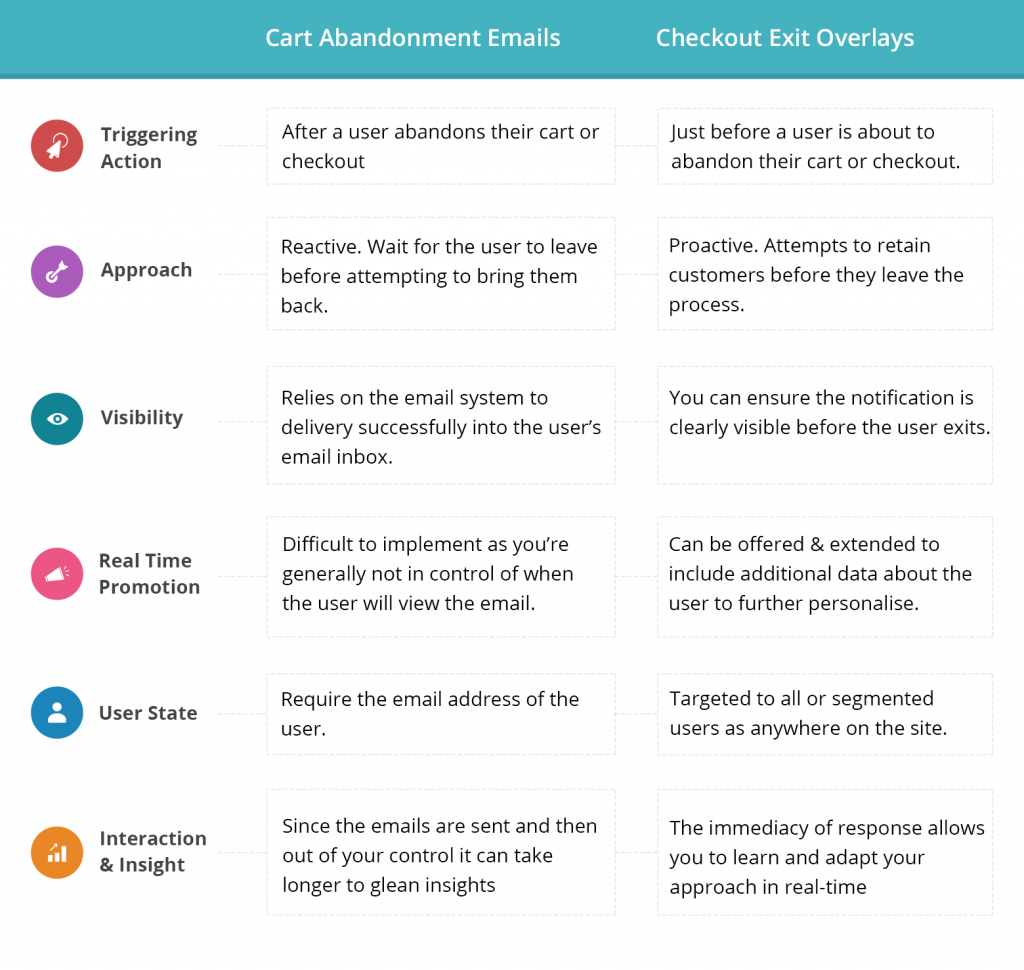
The below table displays the basic differences between Cart Abandonment Emails and Checkout Exit Overlays (popups):
Numbers Speak Louder than Words
“One accurate measurement is worth more than a thousand expert opinions.” — Admiral Grace Hopper
A high cart abandonment rate is an expected but a big disappointment for online retailers. When our clients speak to us about reducing cart abandonment, we suggest initially using checkout exit overlays.
We studied 20 campaigns spread across geographies for two weeks. The data showed an improvement in conversion rates as a direct result.
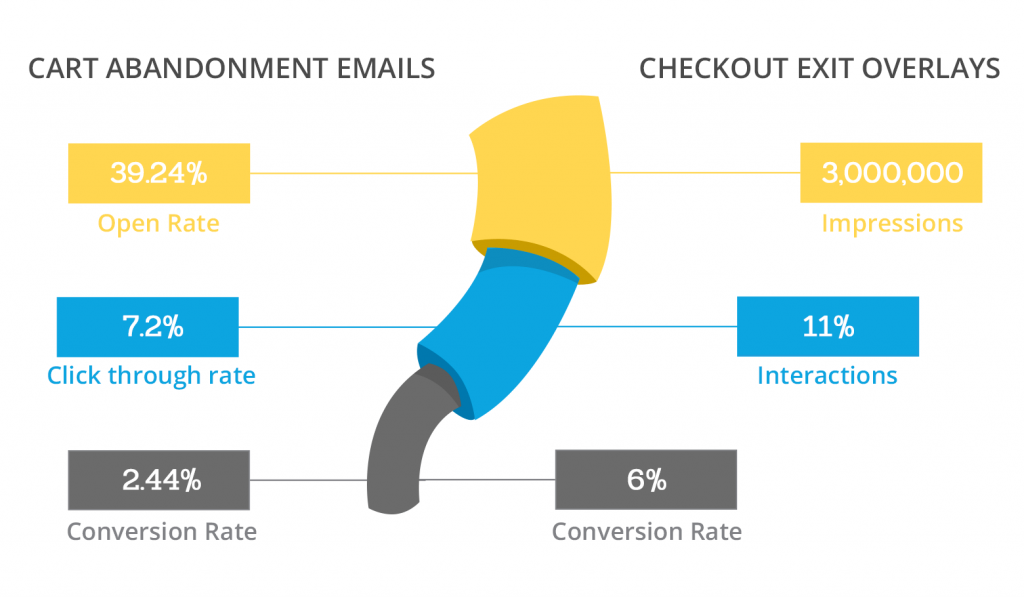
Over the two-week-long period, the 20 cart page campaigns registered 3 million unique impressions, i.e., 3 million users intended to abandon carts and saw an exit-overlay.
Out of this, 11% of customers interacted with these overlays and eventually, 6% converted.
That’s an additional 6% conversion within the checkout process itself.
For comparison’s sake, let us compare the statistics from a case study on cart abandonment emails. The figures are normalized for comparison. Impressions would be equivalent to a 100% open rate in emails. This being true due to targeted Notifications garnering almost 100% view.
Conclusion
Having extensively discussed both approaches with customers, we believe that cart abandonment emails, although, offer a process that can benefit customers and online retailers, lack the ability to handle few critical scenarios.
On other hand, there is less awareness of website notification technology that can have a more immediate impact on retaining the customer and converting them then and there.
Exit overlays should be your first port of call when it comes to reducing cart abandonment. The immediacy and direct response nature of them mean you can have a closer relationship with your customer at a very critical point in their journey. However, we also understand abandoned emails can cast the net wider on re-capturing as many sales as possible.
The best approach is to think broadly about how you can increase cart conversion rates, test, learn, and adapt your approach to ensure whatever you choose, both you and the customer end up in a win: win situation.
The above video illustrates how we at WebEngage help thousands of online businesses rescue abandoned carts. We’d love to hear your experiences and successes while combating cart abandonment.