

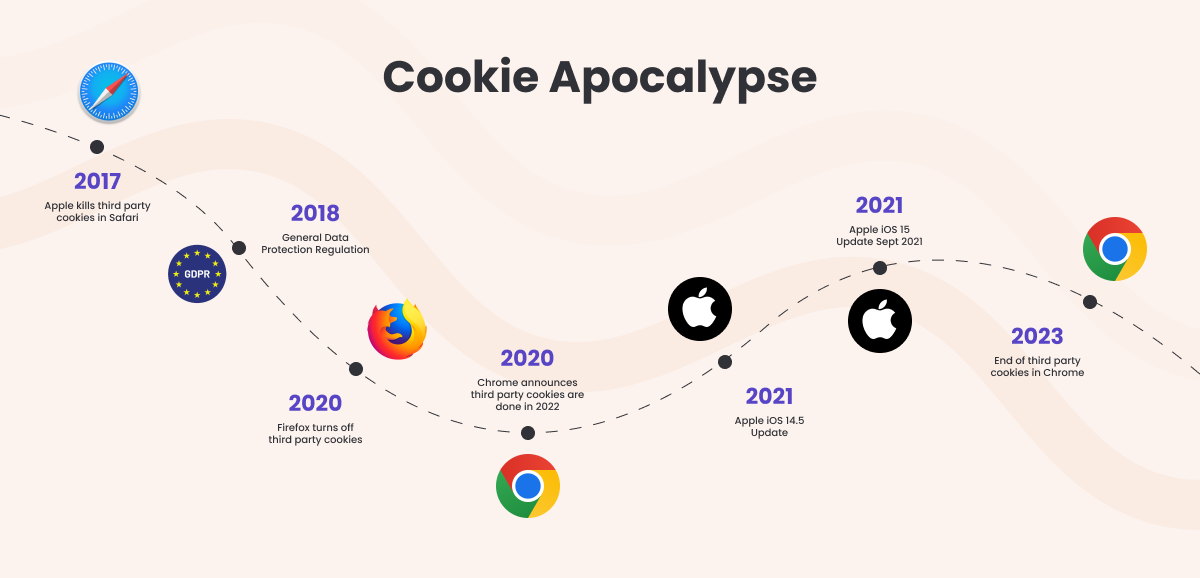
In the ever-evolving digital marketing landscape, a seismic shift is underway as Google finally announces the phasing out of third-party cookies. These tiny bits of data, which have been the silent enablers of targeted advertising, are now hidden behind the curtains of time. As we bid adieu to third-party cookies, let’s unravel the disadvantages that have overshadowed their advantages and explore avenues of user acquisition and engagement in the cookie-less future.
What are third-party cookies?
Third-party cookies are the silent trackers that permeate the online world, used by various platforms to monitor user behavior across different sites, particularly in targeted advertising. From retargeting efforts to analytics and ad measurement, these cookies have been ubiquitous in the digital marketing toolbox.
Retargeting Under Scrutiny
Retargeting, a staple in digital marketing, comes with a dark side. Users often feel stalked and bombarded with ads that seem to follow them online. This intrusive approach can erode user trust and lead to negative brand perception. The limitations of retargeting are becoming increasingly apparent.
With little to no control over ad placement, companies have pulled out of advertising on platforms like X (formerly Twitter) due to controversies involving ads being displayed next to or within content that is deemed inappropriate, offensive, or controversial.
Google’s Decision: A Confluence of Concerns
Google’s move to phase out third-party cookies is not a solitary decision but a response to multiple concerns:
- User Privacy Concerns: A recognition of the growing demand for enhanced privacy protections as regulators and users become more vigilant about online tracking practices.
- Industry-Wide Shift: Directives established by numerous privacy laws and other browsers like Safari, Mozilla, and Microsoft Edge have paved the way for a shift toward privacy-focused browsing experiences. Given Google Chrome’s substantial market share of 61%, the impact of third-party cookies deactivation will be particularly significant.
Reduced ROAS: A New Reality
As third-party cookies fade into obsolescence, businesses should brace themselves for a dip in ROAS. This dip will not be limited to Google Ads world – its ramifications will be felt across all ad platforms, as much as 30% by some estimates.
While Facebook advertising became a key strategy for many D2C brands, this higher demand led to increased competition resulting in costs tripling from $6 to as much as $18 to advertise to 1000 users on Facebook.
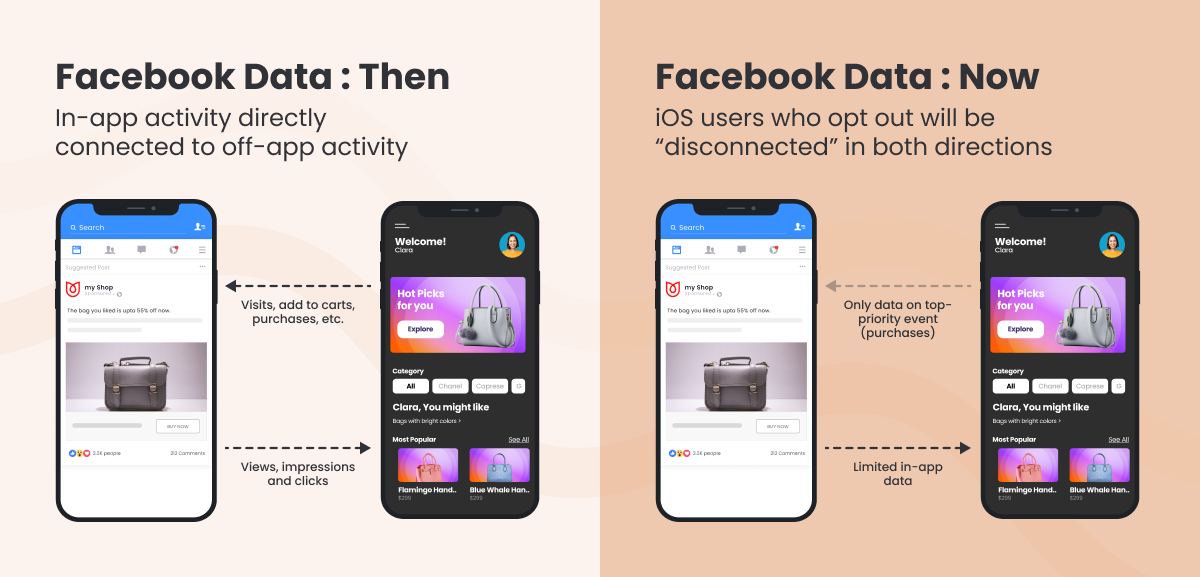
Moreover, the changes introduced by iOS 14.5 hinder advertisers’ ability to attribute sales on Meta platforms, leading to higher advertising costs and reduced tracking accuracy.
While the impact will vary for businesses depending on risk factors such as Digital ad dependency, Digital Mix, Third-party data reliance, and Digital Strategy; Deloitte reports: “Across the companies surveyed, average risk projections (of third-party data depreciation) ranged from around $91 million to $203 million of revenue per year, with some companies risking upward of $300 million in revenue, each.”
WebEngage: Empowering Businesses in a Cookie-less Future
Enter WebEngage, your ultimate ally in the post-third-party cookies era. As a retention marketing tool, WebEngage harnesses the power of first-party data to redefine user engagement:
- Acquiring First-Party Data: Acquire Zero and first party data that can be seamlessly integrated across various channels. Build your own data repository without having to rely on agency-led third-party data sources.
- Leverage first-party data: Engage with users on your website through on-site campaigns – using progressive forms, Web Push, Exit intent forms & surveys to capture their attention and enhance engagement. Choose from 12 channels to create highly contextual communication.
- Re-engaging Users: Converting new customers is a challenging journey from awareness to conversion, with a probability ranging from 5% – 20%. Conversely, the probability of selling to an existing customer falls between 60% – 70%. The cost of acquiring a new customer is 10x the cost of retaining an existing one.
- Maximizing Customer Lifetime Value: Keep track of individual customer preferences, behaviors, and purchase history. Use this information to create targeted & personalized campaigns that resonate with your users, increasing the likelihood of extended customer relationships and maximized CLTV.
Conclusion: Navigating the Cookie-less Future
While many see the cookie-less future as a challenge – we believe it’s an opportunity disguised as a problem. An opportunity to relook at data strategy, to take a long term view, and focus on building zero and first-party data.
WebEngage stands as a guide in this transition, enabling businesses to engage with users effectively, build trust, and foster organic growth. The post-third-party cookies era is not a challenge but a chance to reshape the digital marketing landscape. With WebEngage, your journey to meaningful user engagement has never been clearer.
Book a free demo today to explore how WebEngage can seamlessly transition your business into the era of first-party data, personalized engagement, and sustained growth.